Masaru Emoto's groundbreaking water research

We consider water to be such a banal element that we do not measure its wealth. There is one person who profoundly influenced our understanding of this fundamental element. This is Masaru Emoto, a Japanese who is known worldwide for his revolutionary research on water. Have you ever heard of it?

Throughout his life he conducted experiments that led him to explore the relationship between thoughts, emotions and the molecular structure of water. It's quite fascinating. His crystallization experiments and his discoveries on the influence of sound frequencies are very well known and sometimes controversial, it must be noted. But overall, it brings another vision on the nature of water itself.

In this article, I take you to discover the fascinating world of Masaru Emoto and his work on water. Perhaps you have already heard of the rice experiment? We'll talk about that too! And above all we will see what the implications of the research are on health and well-being.

Photo of Masaru Emoto with crystals on either side, symbolizing his groundbreaking research on the impact of emotions and words on water

Who is Dr. Masaru Emoto?

Masaru Emoto (1943-2014), is a Japanese researcher and author, who is famous for his revolutionary studies on water. Masaru Emoto has dedicated his life to understanding the mysterious properties of water.

He has written numerous works on the subject. You will find the references at the bottom of the page as well as the website dedicated to it.

Masaru Emoto's studies on water

I am sure that you must have already seen these famous photos of crystals. Does that remind you of something ? Well it’s thanks to Mr Emoto that they are famous! He conducted revolutionary research into the power of water and its ability to “print” any information it receives, whether written, oral or musical.

Water crystals and water's hidden messages

These famous photos of water crystals influenced by words and emotions have become very famous. With his experiments he demonstrated how vibrations (whether positive or negative) can modify the molecular structure of water.

Mr. Emoto's work allows us to assess the purity of various types of tap, lake, spring and rain water. In fact, pure water forms magnificent crystals, whereas stagnant water, wastewater and polluted water present incomplete, unstructured or even non-existent crystals.

His work also confirms the "memory of water". They enable us to visualize the effects of different energies on water (external and internal, since 70% of our adult bodies are made up of water), from the most familiar (electromagnetic radiation, music, etc.) to the most subtle (such as the energy of words, shapes and thoughts!).

Photos of crystals formed according to the words and vibrations to which they were exposed, illustrating Masaru Emoto's discoveries on the impact of energy on water

His work confirms that water reacts to all information, positively or negatively. That's why Emoto subtitles his book: "Water's message invites us to look inside ourselves".

To obtain these crystals, he placed water samples in Petri dishes at -20° for three hours.

After freezing the water, he used a microscope to photograph the water crystals formed by the freezing: they would be beautiful if the information previously transmitted to the water was a message of love, or hideous if it was a manifestation of hatred or anger.

The near-perfect crystal was given by a water whose words were written on a sheet of paper that was used to wrap the bottle containing the water. These words are: "Love and Gratitude".

In this regard, Mr. Emoto writes: "The words 'gratitude and love' constitute the fundamental principles of the laws of nature and the phenomenon of life".

This is why water crystals formed from the words "Gratitude and Love" are so perfect in their hexagonal shape. If, on the other hand, words such as "anger", "idiot" and "hate" are combined with water, you won't get crystals, but ugly, mediocre results. This shows that these words have no correspondence in nature and that they are manufactured by that part of man called the ego or mind.

From Mr. Emoto's experiments, it seems that only the vibrations of love, such as joy, peace, beauty, harmony and gratitude, exist naturally in nature, and can be applied to both plant and animal kingdoms.

Crystals formed by the word 'I love you', illustrating the positive impact of words of love and kindness on water, according to Masaru Emoto's research

Mr. Emoto's experiments have far-reaching implications. They demonstrate that human thoughts, intentions and positive thoughts can alter physical reality, such as the molecular structure of water.

Mr. Emoto confirms that " everything is energy ", as Einstein put it. In addition to electromagnetic radiation, words, feelings and even thoughts influence water. Negative words and thoughts lead to disharmonious crystallizations, whereas "thank you" or "love", whatever the language, form beautiful images.

Beautiful crystallization, showing delicate and harmonious crystal formations, symbolizing the beauty of natural structures

The impact of sound frequencies and music on water

Masaru Emoto explored the impact of sound frequencies on water through innovative experiments in which he exposed water to different sound vibrations. One of his methods involved playing music, speaking words or emitting positive or negative intentions near water, before examining it in the form of frozen crystals.

In his most famous experiments, Emoto used distilled water, which he froze to observe the formation of crystals. When the water was exposed to harmonious musical vibrations or positive words, the crystals that formed had symmetrical, aesthetically pleasing structures. In contrast, when the water was subjected to discordant vibrations or negative words, the crystals formed in a chaotic, unstructured manner.

These experiments suggested that sound frequencies, whether emitted by music, speech or intentions, could influence the way water crystallized, and therefore could impact its structure. From there he deduced that there was a link between the quality of our words and the quality of the water. If the result of this research was extraordinary for the general public, it was far from being the case for certain members of the scientific community. They particularly criticized Emoto for the lack of methodological rigor and concerns about reproducibility of experiments.

Yet it's enough to observe for yourself the impact of words of love or hate spoken against you. If someone yells at you with words of hatred, do you think you'll feel as good as if they say words of kindness, love or compassion? Try observing this in your own life.

Dr. Emoto's rice experiment

To replicate Emoto's experiment, a Japanese mother placed cooked rice in two jars. She marked one "I love you" and the other "I hate you", and repeated these words to the rice for two weeks. The rice given the words "I love you" remained white and preserved well, while the rice in the other jar turned black and mildewed.

This experiment is easily reproducible, provided the jars are sterilized, placed in the dark and spoken to with conviction.

After 15 days, the difference is clearly visible between the rice given the words "thank you" and a control jar in which the rice is left to mildew normally. The same result is achieved by writing only the word "thank you" on the pot. It's also possible to focus the thoughts "I love you" on one pot and "I'm going to kill you" on the other for a minute, and a very clear difference appears, which continues to grow after the 15-day experiment. This simple rice experiment, which can be reproduced at anyone's leisure, is a simple way of seeing the influence of mind on matter.

The link between matter and consciousness, explored by Masaru Emoto in his experiments, shows that reconciling science and spirituality is possible, and even desirable.

Our thoughts and emotions influence the world far more than we realize, and the rice experiment enables everyone to verify this.

The worrying state of both the environment and the health of modern man, who is largely cut off from the spiritual dimension, suggests that it would be beneficial to overcome certain taboos, and reconcile ourselves with the concept of an intelligent and loving universal consciousness, which generates and runs through all things.

The impact of his research

Criticism and support

Despite popular success, Emoto's work has been subject to scientific criticism. Some question the methodology and scientific validity of his experiments, while others hail his contribution to collective consciousness about water.

Emoto's legacy in spirituality and culture

Emoto's ideas have transcended the scientific realm to influence spirituality and culture. His book,"The Hidden Messages of Water", has inspired many to see water as a mirror of our thoughts and emotions.

Implications for health and well-being

Water in the human body

Based on his findings, Emoto suggests that the quality of the water we consume can have an impact on the health of all human beings. This perspective has sparked discussions about water as a key element in our physical and emotional well-being.

Practical applications of Emoto's research

Some people have adopted Emoto's teachings into their daily lives, seeking to energize their water to improve its quality. Companies, including us, have even developed products claiming to follow the principles of "informed" water according to his research.

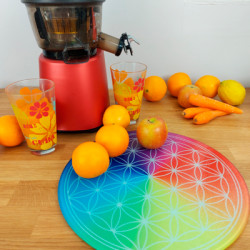
Just as Mr. Emoto has demonstrated, and knowing that everything is alive and energized, if you place your water or food on our sacred geometry symbols, you impregnate them with the energy that corresponds to them and you communicate this information, this energy to your body, which is transformed.

Similarly, if you hang a Flower of Life canvas or a Mandala canvas on your wall, each mandala or symbol will radiate into your living or working space. You can use our products in different ways, depending on your needs, but remember that each mandala or symbol radiates and emits a specific vibration.

Masaru Emoto and his water research: true or false?

As I indicated a little above, Masaru Emoto's research on water has been well criticized by the scientific community who consider it not very rigorous.

Other researchers have questioned the validity of the experiments due to methodological problems and a lack of standardized experimental protocols.

And what's more, the problem is that other scientists have not been able to reproduce Emoto's results, which means that the work has been criticized for its lack of transparency and scientific rigor.

That being said, isn't the true researcher the one who looks into both worlds, the visible world and the invisible world, and knows that everything has an influence: thoughts, actions, etc.? I leave that to your consideration!

Masaru Emoto's legacy and water consciousness

Never mind the controversies. What we can remember is that this research has opened doors to new perspectives on the way we consider water. And then they also sparked scientific debates afterwards.

As a result, whether we adhere to his theories or not, these discoveries or experiments have left an indelible imprint on the way we perceive water, science, and even our own emotions.

Masaru Emoto's books on water

Les messages cachés de l'eau - Emoto Masaru, Ed. TREDANIEL
L'eau, mémoire de nos émotions - Emoto Masaru, Ed. TREDANIEL
L'eau et le devenir de la Terre - Emoto Masaru, Ed. TREDANIEL
Le miracle de l'eau - Emoto Masaru, Ed. TREDANIEL
Doctor Masaru Emoto's website: http://www.masaru-emoto.net/english/index.html

Download his children's book in PDF (also very instructive for older children!)

Related posts

Share this content

Add a comment

Search on blog