
Viking Symbols: Myths, Mysteries, and Truths

For over a thousand years, the Viking world has continued to capture our imagination. Gods, runes, sacred trees, hammers, interlacing patterns… behind these representations lies a worldview where the visible and the invisible seem to be in constant dialogue. Even today, Viking symbols fascinate us as much for their aesthetic appeal as for the mysteries and beliefs that surround them.
But what do we really know about Viking symbols and their meanings? Behind Thor’s hammer, the Valknut, the runes, and the figures associated with Odin lies a world of protection, destiny, invisible forces, and the quest for knowledge. However, the meanings we attribute to them today are not all as ancient—nor as certain—as one might think.
Archaeological remains coexist with mythological accounts recorded at a later date, while certain modern interpretations have come to be confused with history. Even more surprising is that some of the most famous symbols we now call “Viking” do not even date back to the Viking Age.
Distinguishing history from myth, however, does not dispel the mystery. On the contrary, it allows us to look beyond appearances to discover what these symbols can reveal about Norse spirituality, the relationship with the invisible, and how the ancient Scandinavians viewed protection, knowledge, death, and even destiny.
Between history, mythology, and esotericism, let’s follow in the footsteps of Viking symbols to try to untangle what we know, what the myths tell us… and what remains a mystery.
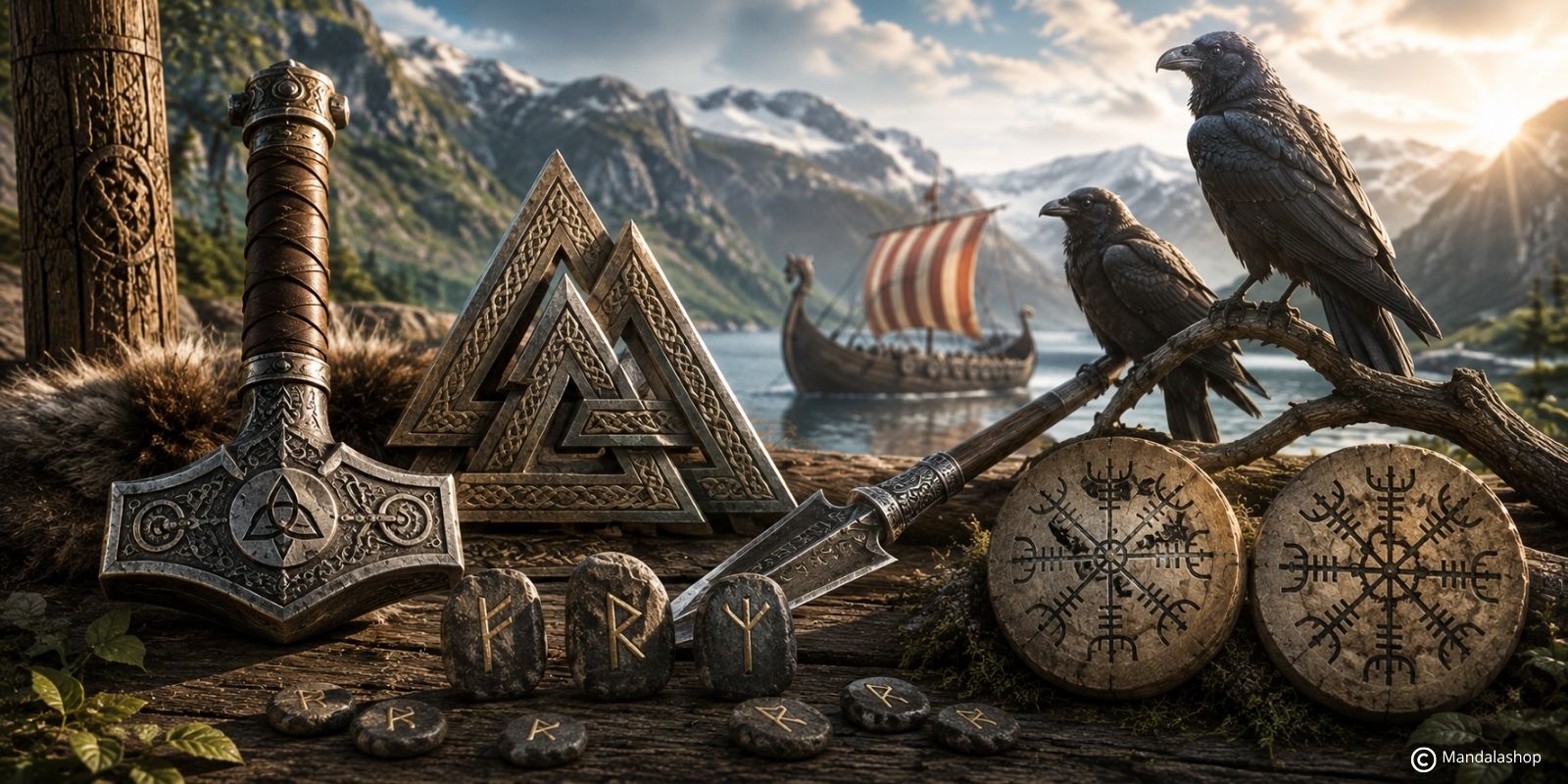
What do we really know about Viking symbols?
When discussing Viking symbols, we must first ask ourselves a fairly simple question: what do we really know about the beliefs of the men and women who lived in Scandinavia over a thousand years ago?
Less than one might imagine.
The Vikings left us no major texts explaining their religion, their symbols, or their worldview. To try to understand them, historians and archaeologists must therefore piece together a vast puzzle: objects discovered in graves and places of worship, amulets, runestones, place names, skaldic poetry, accounts by foreign travelers… as well as accounts written after the Viking Age. The National Museum of Denmark describes our knowledge of the ancient Norse religion as a collection of fragments from very different eras and authors.
When Objects Tell a Story
Some artifacts are particularly valuable because they date directly from the Viking Age. Pendants shaped like Mjölnir, Thor’s hammer; depictions of deities or Valkyries; offerings; graves; and the remains of possible places of worship provide tangible evidence of ancient practices and beliefs.
Unfortunately, however, an object does not come with an explanatory note.
Finding a symbol in a grave tells us about its existence, its context, or sometimes its significance, but not necessarily about everything it meant to the person who wore it. That is where part of the mystery begins.
And we must guard against another temptation: imagining a perfectly codified Nordic religion that was identical throughout the Scandinavian world. Archaeological research, on the contrary, reveals local practices and regional differences. The Swedish History Museum speaks more of siðr—that is, customs and practices—than of a uniform religion comparable to those we know today.
The Eddas: A Window into the Past… Several Centuries Later
Many of the stories we associate today with Odin, Thor, Loki, Freyja, or Yggdrasil have come down to us through the Eddas.
The Poetic Edda compiles poems from an even older oral tradition.Snorri’s Edda, on the other hand, is the work of the Icelander Snorri Sturluson, written in the 13th century. These texts are fundamental to understanding Norse mythology, but they were written down after the Viking Age had ended and Scandinavia had largely adopted Christianity.
This does not mean that everything they recount was invented after the fact. Some stories seem to preserve much older traditions, and archaeology sometimes provides material evidence that echoes the myths passed down through the texts. But history, archaeology, and mythology must not be confused.
This is particularly important when seeking the meaning of a Viking symbol.
Can a symbol really have just one meaning?
Our modern perspective favors simple associations: one symbol for protection, another for courage, yet another for wisdom or love.
The sources available to us, however, reveal a symbolic universe that is far less rigid. Gods, fate, death, protection, fertility, ancestors, and the forces of nature are all intertwined within it, while practices could vary according to era, region, and context.
That is why, in the following chapters, we will distinguish as much as possible between three levels of interpretation: what archaeology confirms, what texts and myths tell us, and the symbolic or esoteric interpretations that emerged later.
This distinction, incidentally, holds a few surprises. For some of the most famous “Viking symbols” that we see everywhere today… were probably never seen by a Viking.
Major Viking Symbols and Their Meanings
While it is difficult to assign a single meaning to Viking symbols, some of them appear frequently enough in archaeological remains and Norse sagas that we can begin to understand their language.
And this language ultimately says very little about war itself. It speaks of protection and chaos, of death and transition, of knowledge, memory, destiny, and the connections between worlds.
This is undoubtedly where Viking symbols become most interesting: when we stop viewing them as mere war emblems and instead enter into the worldview they seem to embody.
Mjölnir: Protection Viking Symbol
It’s impossible to discuss Viking symbols of protection without starting with Mjölnir, Thor’s famous hammer.
Unlike many symbols now considered Viking, its use during the Viking Age is well documented. Hammer-shaped pendants, made primarily of iron or silver, have been discovered in graves, settlements, and hoards throughout Scandinavia and beyond. The Swedish History Museum also notes that rings featuring small hammers have been found in funerary and ritual contexts. Their exact function remains a matter of debate, but their connection to Norse religious practices is beyond doubt.
But protect against what?
This is where Mjölnir becomes much more interesting than the modern image of a hammer that simply embodies strength.
In Norse mythology, Thor regularly confronts giants and forces that threaten the balance of the world. He protects Midgard, the world of humans, and emerges as one of the defenders of cosmic order against the forces of chaos.
Mjölnir is therefore a weapon, but its symbolic function goes beyond destruction: it strikes to preserve order.
Thor also intervenes at pivotal moments in existence. Archaeological sources and discoveries associate his hammer with protection, but also with fertility, funeral rites, and certain forms of consecration.
This dimension opens up a particularly rich symbolic interpretation. Wearing Mjölnir today may evoke strength, certainly, but perhaps even more so the ability to preserve what must be preserved when everything around one threatens to descend into chaos.
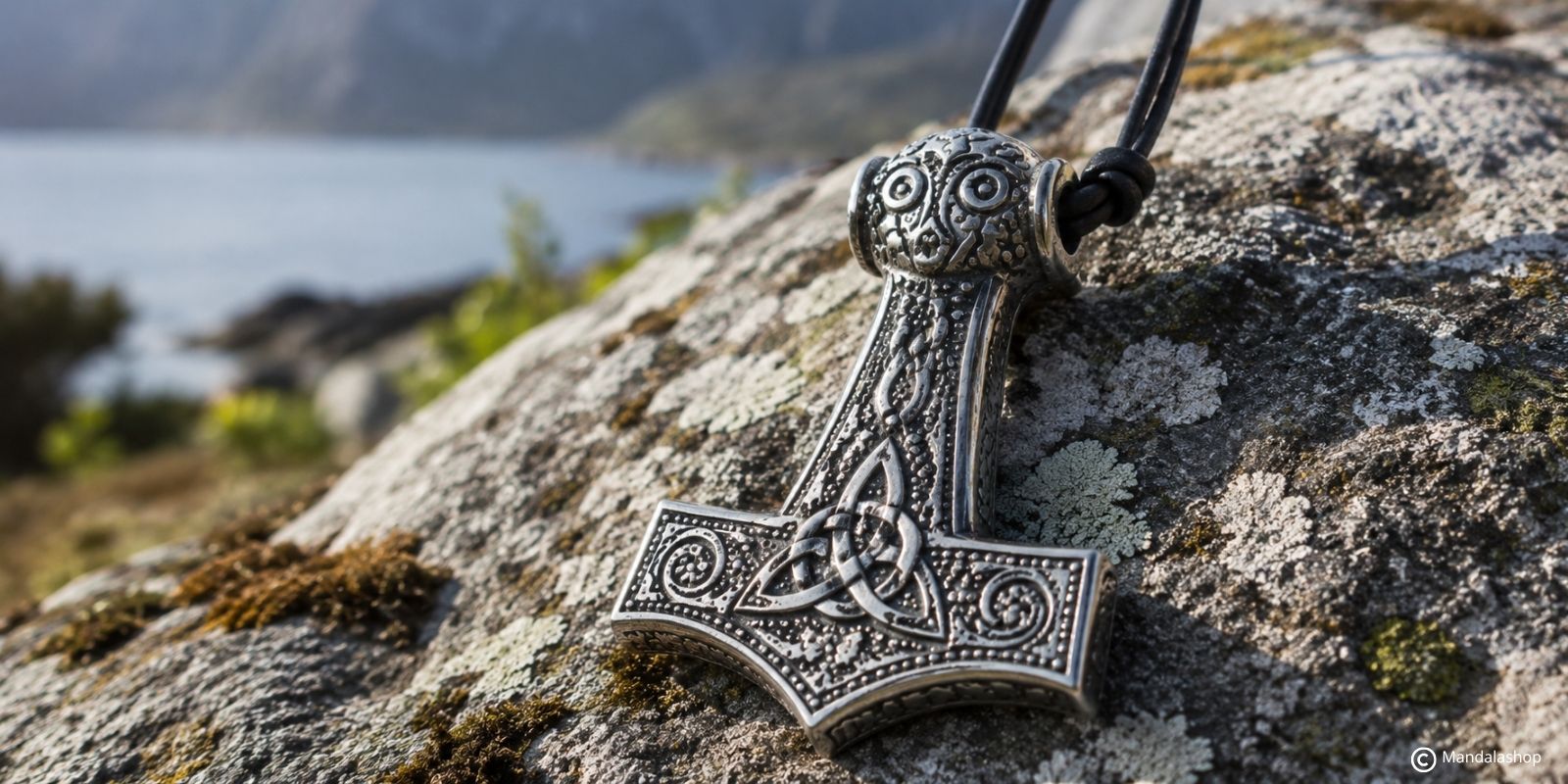
The Valknut: Odin, Death, and the Journey
Three intertwined triangles. Nine points. Few symbols seem as immediately “Viking” as the Valknut.
And yet, we don’t even know what the Vikings called it.
The term “Valknut” is a modern one. The symbol appears notably on Gotland runestones and in iconographic contexts related to death. On the famous Stora Hammars I stone, for example, the three triangles appear near a scene featuring a figure armed with a spear, a hanged figure, and what could be a raven—all elements that have led scholars to associate this depiction with Odin.
Its association with Odin, fallen warriors, and the passage to the afterlife is therefore plausible. But its exact meaning remains unknown, and there is no consensus allowing us to assert that “the Valknut means this,” as is so often claimed.
And that is precisely what makes it so fascinating.
One commonly cited interpretation links the Valknut to Odin’s power to bind and unbind. Odin reigns over Valhalla and welcomes some of the warriors who have fallen in battle; the Valkyries choose those who will join his realm.
Symbolically, the intertwined triangles have thus come to evoke death, the transition from one state to another, and the connections between different planes of existence.
As for the nine points of the Valknut, it is tempting to link them to the nine worlds of Norse cosmology. This interpretation is widespread today, but it is not historically proven. It is important not to turn a beautiful symbolic correspondence into an archaeological certainty.
The Valknut thus confronts us with something essential in our relationship to ancient symbols: sometimes, mystery is part of the symbol itself.
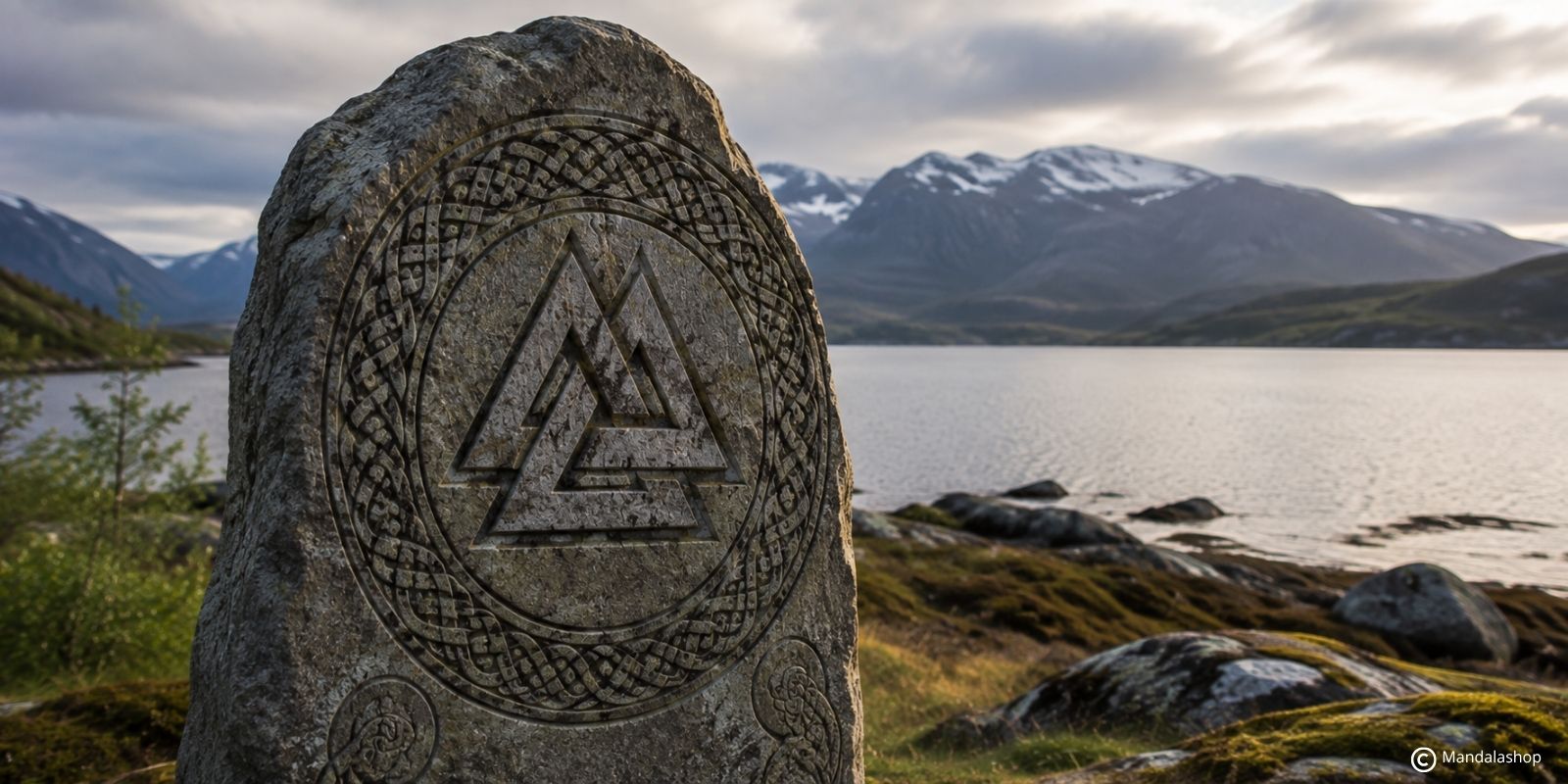
Gungnir: Odin’s Spear, Between Power and Sacrifice
Just as Mjölnir is inseparable from Thor, so is Gungnir from Odin.
In Norse mythology, this extraordinary spear belongs to the god and is one of the marvelous objects forged by the dwarves. However, it should not be reduced to merely a weapon of war.
The spear also appears in one of the most mysterious episodes associated with Odin. In the Hávamál, the god describes himself hanging from the tree, wounded by a spear and offered up to himself, during the ordeal that will lead him to the knowledge of the runes. Behind this sacrifice lies one of his fundamental traits: knowledge comes at a price.
In a contemporary symbolic interpretation, Gungnir can thus evoke authority and power, but also a commitment to a quest whose consequences one accepts: it is no longer merely the spear that hits its target, but the intention that cannot be taken back once launched.
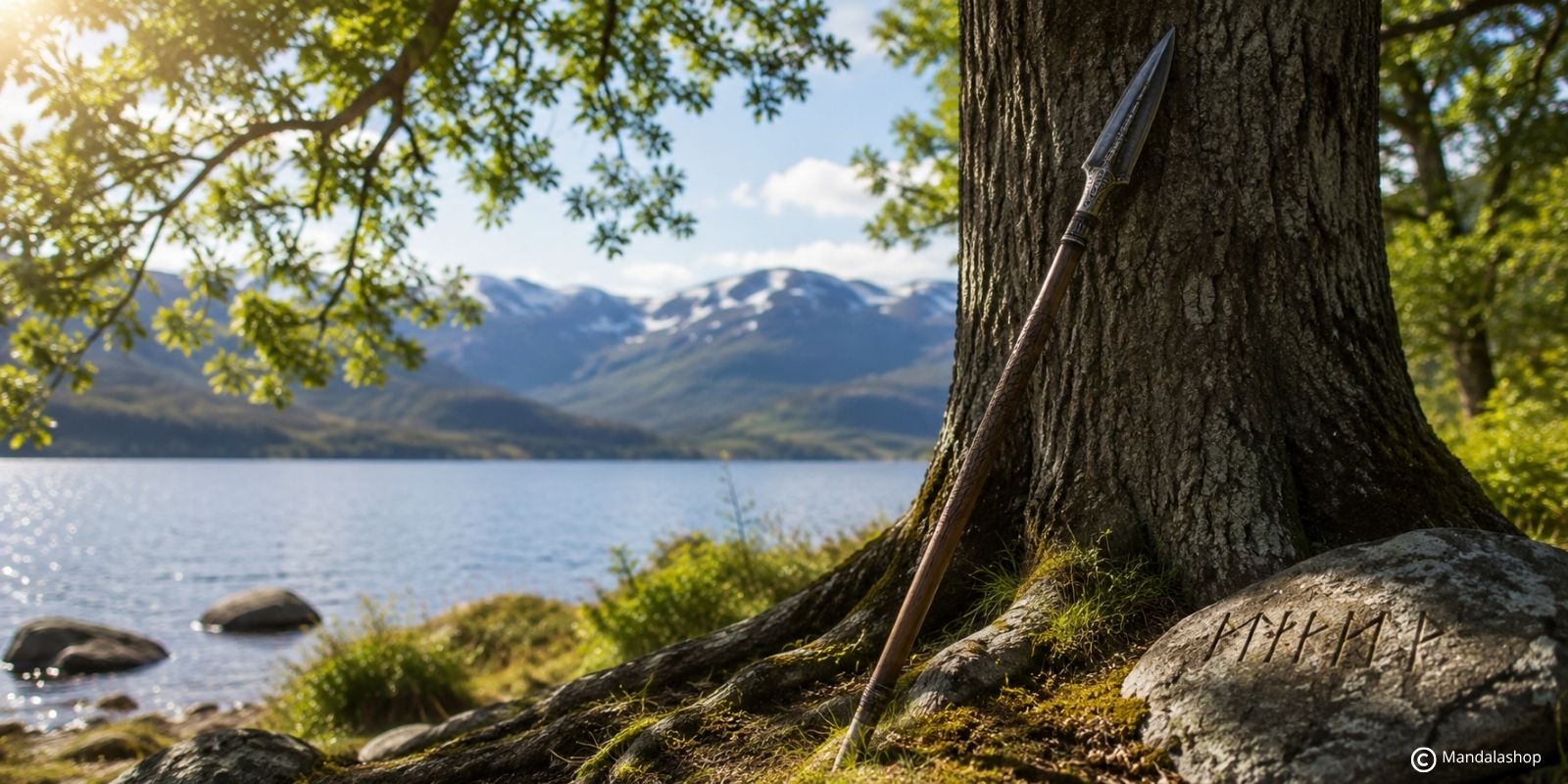
Huginn and Muninn: Thought and Memory
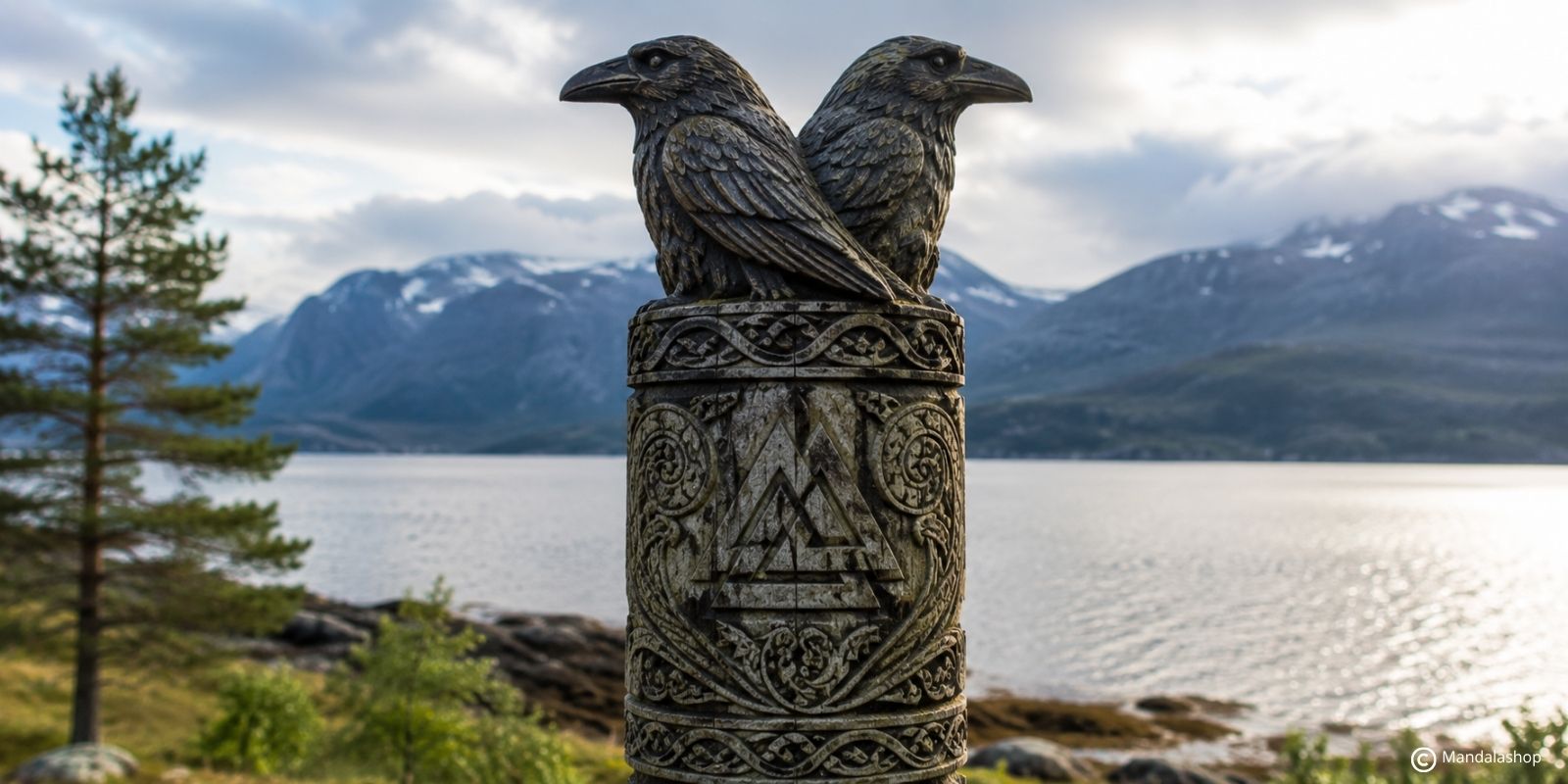
Two ravens accompany Odin: Huginn and Muninn.
Their names are generally associated with thought (Huginn) and memory (Muninn). According to Norse tales, Odin sends them out every day to travel the world. They then return to report to him what they have seen and heard. The Swedish History Museum also depicts the two birds as traveling the world daily to bring knowledge back to Odin.
The image is powerful in itself: Odin does not see everything from his throne. He sends thought and memory out to explore the world to expand his knowledge.
But the raven takes on another dimension in Norse mythology.
As the bird of battlefields and the dead, it naturally maintains a connection with Odin, the god of war and fallen warriors. Depictions of birds also appear in the iconography of the period, although their identification as Huginn and Muninn is not always certain. The British Museum notes, for example, that a bird depicted on a Viking coin from York could represent Odin’s raven… or the Christian eagle of Saint John.
This uncertainty is interesting: once again, recognizing a raven does not automatically mean recognizing Huginn or Muninn.
On a symbolic level, however, their pairing sparks a remarkable line of thought. Thought without memory would be condemned to endless repetition; memory without thought would remain trapped in the past.
Together, they become the two essential movements of knowledge: observing the world and preserving what it teaches us.
Yggdrasil: The World Tree
At the center of Norse cosmology stands Yggdrasil, the immense World Tree around which the various realms of the universe are organized.
Gods, humans, giants, the dead, and mythical creatures thus belong to different worlds without being entirely separate: their realities exist within the same cosmic structure.
But Yggdrasil is not a symbol of static harmony. Its roots are threatened, creatures live in its branches and on its trunk, and the tree itself plays a part in the upheavals of Ragnarök. It is a living, vulnerable world in perpetual transformation.
Its symbolism is therefore much richer than that of a simple “tree of life.” Yggdrasil evokes both the interconnection of the worlds, the cycles of existence, and that strange unity that links realities that are, yet, opposites.
We have dedicated an entire article to Yggdrasil and its meaning, in which we explore its place in Norse mythology, its nine worlds, and its full symbolic significance.
Mjölnir leads us toward protection and the maintenance of order; the Valknut toward Odin and the mystery of death; Gungnir toward power and the quest for knowledge; Huginn and Muninn toward thought and memory, while Yggdrasil connects the various worlds of Norse cosmology. However, not all of these meanings carry the same degree of historical certainty: some are supported by archaeology and texts, while others remain interpretations, whether ancient or contemporary.
Viking Runes: Sacred Writing or Magical Language?
Few elements of Norse culture are today shrouded in as much mystery as the Viking runes. They are often believed to possess powers of protection, divination, or transformation. Yet, before they were esoteric symbols, runes were first and foremost a writing system.
They were used to inscribe names, commemorate the dead, mark objects, or recount journeys. But certain inscriptions and accounts also suggest that, under certain circumstances, they could take on a ritual or magical dimension.
Did the Vikings use the 24 runes of the Futhark?
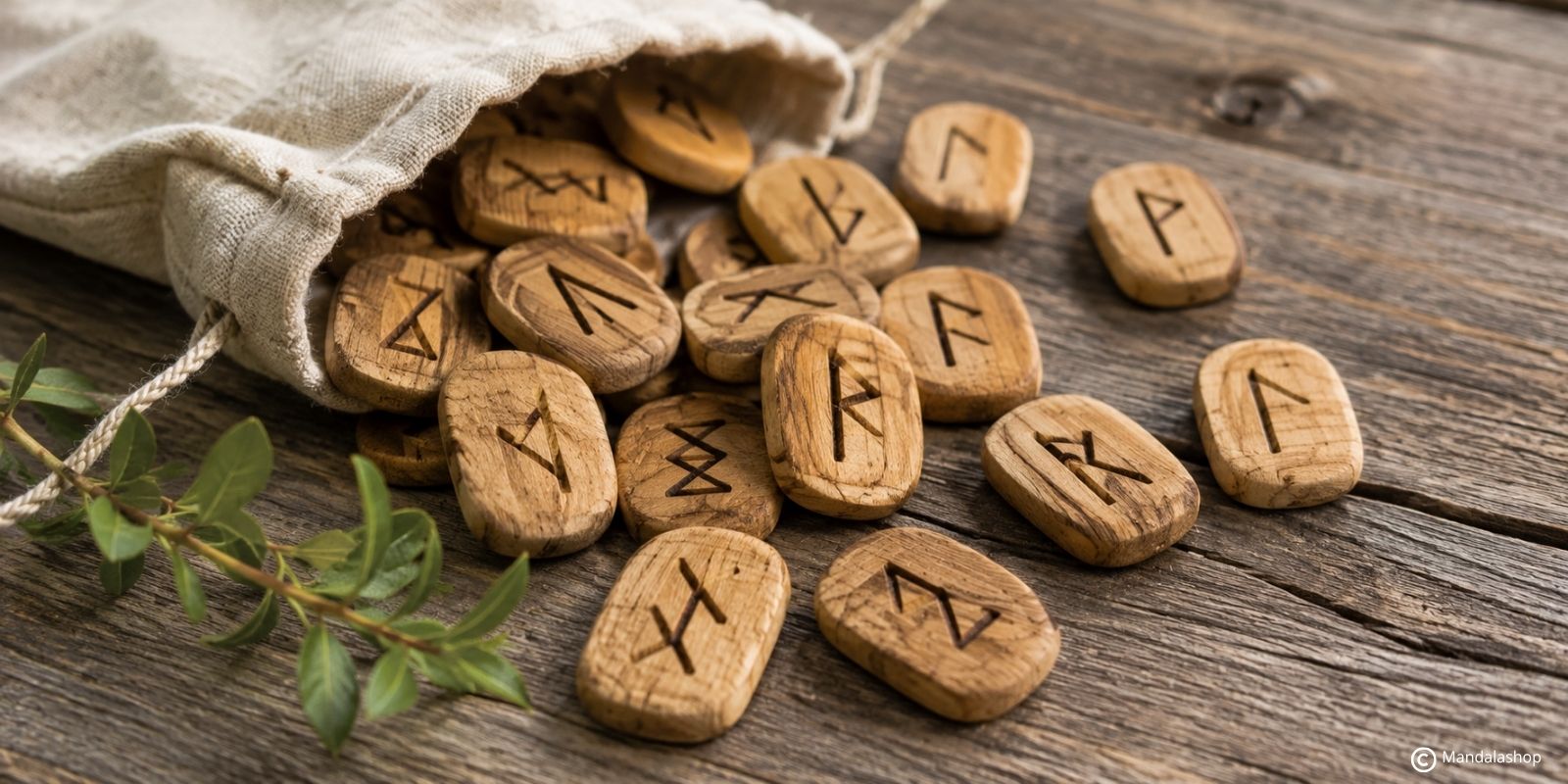
This is one of the most common misconceptions. The famous charts of 24 runes that we see today correspond to the Old Futhark, which was used before the Viking Age.
From around the year 800 onward, the Scandinavians primarily used the Late Futhark, consisting of only 16 runes. These symbols were carved into stone, as well as into wood, bone, horn, weapons, jewelry, and various everyday objects.
In other words, runes were not necessarily mysterious symbols reserved for occult practices. They were also part of everyday life.
Odin and the Secret of the Runes
Mythology, however, gives them a whole new depth.
In the Hávamál, Odin recounts having hung from a tree for nine nights, wounded by a spear, without food or water. At the end of this ordeal, he discovers the runes and makes them his own.
Knowledge of the runes is presented here as something that is not simply received: it is earned through transformation and sacrifice.
This is likely one of the reasons why they hold such a special place in the Nordic esoteric imagination today.
Did runic magic really exist?
Some sources suggest so, but we should avoid imagining a magical system as codified as the one presented in many contemporary works.
The sagas tell of runes used to protect, heal, or curse. Archaeology also provides some intriguing evidence. The Glavendrup runestone in Denmark, for example, contains an invocation asking Thor to consecrate the runes, followed by a curse against anyone who damages the monument.
But the majority of known inscriptions are much more mundane. And a significant portion of the explicit accounts concerning runic magic comes from texts written after the Viking Age.
The same caution applies to the individual meanings we attribute to runes today—Fehu for abundance, Raidho for travel, Algiz for protection, for example. The names of the runes and ancient runic poems do provide many symbolic associations, but there is no evidence to suggest they formed a perfectly codified Viking esoteric system in which each rune possessed a fixed “power.”
The reality is undoubtedly more subtle: runes could be used to write, to name, to transmit memory, and, in certain contexts, to convey a ritual or magical intention.
Perhaps this is where their true mystery lies: in that boundary where writing and acting upon reality sometimes seem to converge.
Protection and Magic: How Did the Vikings Invoke the Invisible?
In the Norse world, protection does not seem to have relied on a single Viking symbol to which a specific power was attributed. Rather, it was part of a broader relationship with the gods, the forces of nature, fate, and an invisible world that people sometimes sought to influence.
Amulets, inscriptions, offerings, invocations, and magical practices thus bear witness to a spirituality deeply rooted in everyday life.
Placing Oneself Under the Protection of the Gods
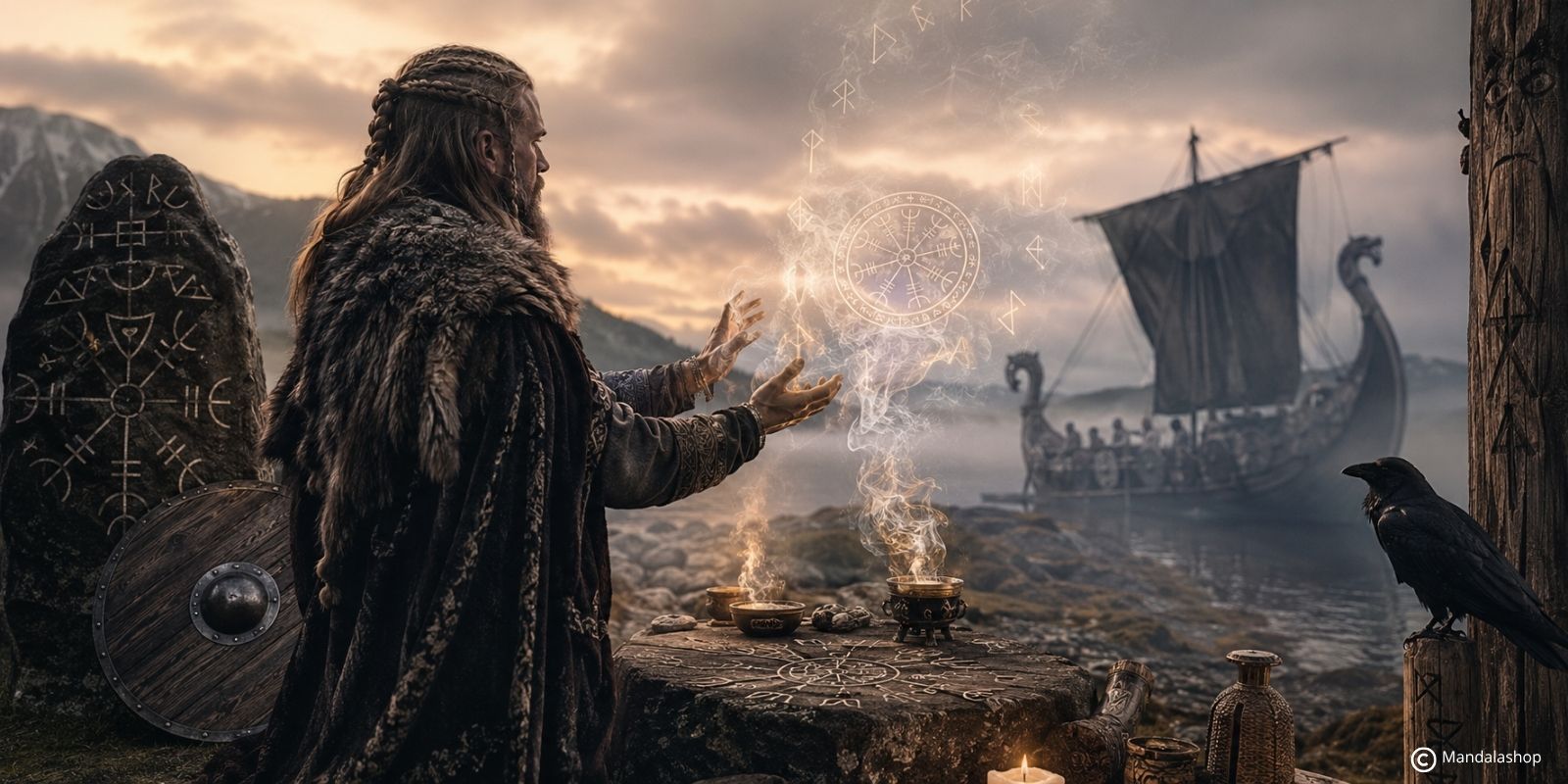
Mjölnir is undoubtedly the most obvious example: as we have seen, Thor’s hammer could be worn as an amulet, and certain runic inscriptions directly invoke the god. On the Glavendrup Stone in Denmark, a formula asks Thor to consecrate the runes.
But protection did not come solely through symbols. Archaeological discoveries also reveal offerings of objects, weapons, jewelry, animals, and sometimes even human beings. These acts may have been intended to secure the favor of divine powers, ensure fertility, or preserve the balance between humans and the invisible world.
Protection thus appears less as a permanent magical shield than as a relationship to be nurtured with the powers that govern the world.
Seyðr: Influencing the Unseen
Among Norse magical practices, seiðr holds a special place.
Medieval texts associate it in particular with divination, the alteration of fate, and various forms of magical action. Odin himself is depicted as knowledgeable in seiðr, but this practice is most closely associated with Freyja, who is said to have taught it to the Aesir.
Some women who practiced this form of magic are referred to in sources as völur (völva in the singular). They could act as seers and perform rituals designed to gain access to knowledge inaccessible by ordinary means.
Archaeology has uncovered several female burials containing strange iron rods that some researchers link to the rods attributed to the völur in the texts. This interpretation remains controversial, but the connection between these objects, certain particularly rich graves, and accounts of magical practices is strong enough to warrant serious study.
We are therefore a long way from the modern image of magic based solely on a few symbols to be drawn or worn.
Protection, destiny… or a dialogue with the invisible?
This is probably one of the most interesting differences between our current approach to Nordic symbols and the one suggested by ancient sources.
We readily seek out “the Viking symbol of protection,” as if there were a universal sign capable of fulfilling this function. The Scandinavians of the Viking Age seem to have had a much more complex relationship with the unseen: they would invoke a god, consecrate an inscription, make an offering, and sometimes consult someone capable of accessing what eluded others.
And above all, not everything could necessarily be avoided.
Fate plays a significant role in Norse tales. Knowing what is to come does not always mean being able to prevent it. Magic might have sought to alter the course of events, but it coexisted with the unsettling idea that part of existence lies beyond our control.
This is perhaps where Norse spirituality becomes particularly interesting: protecting oneself did not necessarily mean controlling the invisible, but learning to come to terms with it.
And this brings us to a rather intriguing paradox: some of the symbols we use today specifically to protect or guide us are presented as “Viking”… even though they appeared several centuries after the Vikings themselves.
These “Viking” Symbols That Aren’t Really Viking
They’re everywhere: on jewelry, tattoos, esoteric items, and even in search results for Viking symbols. Yet some of the symbols most closely associated with the Vikings today didn’t appear until several centuries after their era had ended.
This is particularly true of the Vegvísir and the Ægishjálmur. Does that mean we should exclude them from Norse culture? Not necessarily. Their history is simply different—and deserves to be told as such.
Vegvísir: The “Viking Compass” That Wasn’t One
The Vegvísir is probably the most famous example. Its Icelandic name can be understood as “the one that shows the way ” or “path indicator,” which explains its modern nickname, the Viking compass.
However, there is currently no archaeological evidence to support the claim that the Vikings used this symbol.
One of its best-known references appears in the Huld Manuscript, an Icelandic collection of magical symbols compiled in the 19th century by Geir Vigfússon. This was nearly eight centuries after the conventional end of the Viking Age. The Icelandic tradition of galdrastafir, or magical signs, developed and was passed down within a profoundly transformed cultural context, where Nordic heritage intersected with Christian and European influences.
The manuscript accompanies the Vegvísir with a remarkable promise: whoever bears this sign should not lose their way, even under difficult conditions.
This is the origin of its current symbolism of orientation, guidance, and protection along the path.
The Vegvísir is therefore not a Viking symbol in the historical sense. Rather, it is an Icelandic magical symbol stemming from a later Nordic tradition. This distinction does not diminish its significance; on the contrary, it helps us understand how a symbol can endure through the centuries, evolve, and take on new meanings.


Ægishjálmur: The Mysterious Helm of Terror
The Ægishjálmur, or “Helmet of Terror,” raises an even more intriguing question.
The term itself is ancient. In medieval Norse literature, notably the *Völsunga saga*, the hero Sigurd seizes an *ægishjálmr*—associated with terror and power—after the death of the dragon Fáfnir.
But note: this does not mean that the eight-pointed graphic symbol we know today already existed during the Viking Age.
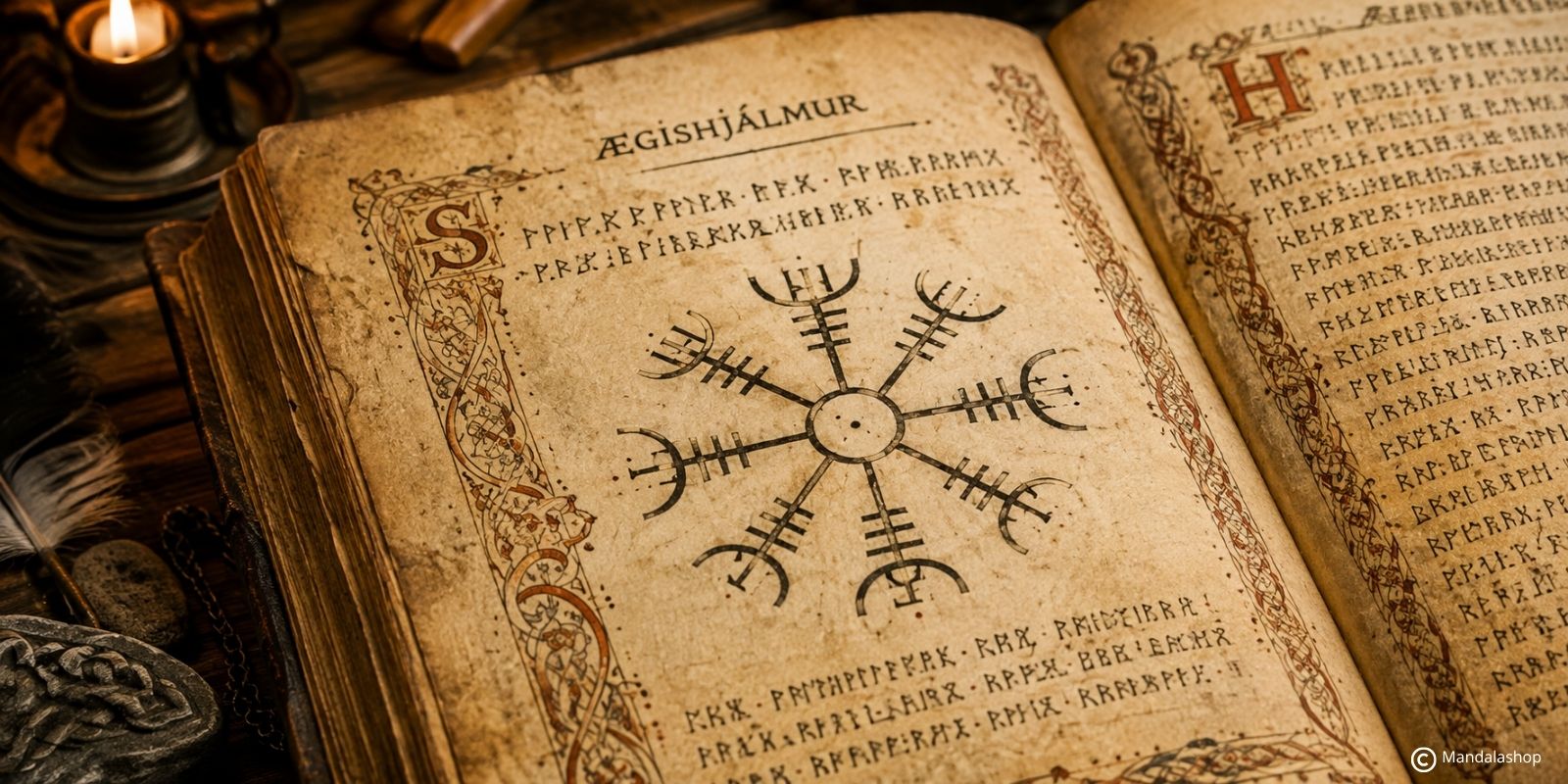
This representation belongs to Icelandic magical traditions documented much later. A 17th-century manuscript preserved and displayed by the Museum of Icelandic Witchcraft and Magic notably includes an Ægishjálmur among various magical symbols.
This is a particularly revealing distinction: an ancient idea can survive without its graphic representation also being ancient.
The Helm of Terror from the tales and the Ægishjálmur depicted in Icelandic grimoires should therefore not be automatically conflated. The graphic symbol we use today belongs more to the history of Icelandic magic than to that of the Vikings.
Does a symbol have to be Viking to have meaning?
That is ultimately the most interesting question.
Describing the Vegvísir or the Ægishjálmur as Nordic symbols isn’t absurd: they belong to an Icelandic cultural tradition that is part of the Nordic heritage. However, presenting them as symbols used by the Vikings is historically misleading.
And that doesn’t take anything away from them.
A symbol can be ancient without being Viking. It can inherit a tradition, transform, incorporate new influences, and continue to carry meaning centuries later.
This distinction between historical origin and symbolic heritage is essential. It allows us to preserve the full mysterious and esoteric dimension of these symbols without needing to invent a past for them.
This may even be one of the most beautiful characteristics of symbols: they never remain completely frozen in time. They travel, transform, and continue to speak to those who encounter them.
Why do Viking symbols still resonate with us today?
More than a thousand years separate us from the Viking Age, and yet its symbols continue to fascinate us. Perhaps because, beyond the gods and the stories associated with them, they touch on deeply human experiences: seeking one’s path, facing the unknown, protecting oneself, understanding the world, accepting change, or making sense of what is beyond our grasp.
Mjölnir can thus evoke the strength needed to preserve what matters when balance is threatened. The Valknut confronts us with the passage of time, death, and the mystery of what lies beyond. Huginn and Muninn, thought and memory, remind us that knowledge arises as much from our ability to observe as from our ability to remember. As for the runes, they embody the fascinating idea that a symbol, when imbued with intention, can become more than just a line drawn on paper.
Even symbols that emerged long after the Viking Age continue this quest. The Vegvísir, for example, does not need to have guided the Vikings across the seas to retain its magnificent symbolism today: that of finding one’s way when one is no longer quite sure where to go.
Perhaps this is where the true power of Nordic symbols lies. Their value depends not only on their age but also on our ability to connect with what they represent. A symbol endures through time because each era reexamines it, questions it, and sometimes gives it new meaning.
This does not mean that all interpretations are equally valid, nor that we must reinvent their history. Distinguishing what is historically attested from what belongs to myth or to a contemporary esoteric interpretation allows us to approach these symbols differently: without stripping them of their mystery, but without inventing false powers or false origins for them.
Because ultimately, from the stones engraved over a thousand years ago to the symbols we still choose to wear today, one question remains: what does this symbol reveal about us?
And what if some of these Viking symbols were to join our shop one day? Mjolnir, Valknut jewellery… tell us in the comments which ones you’d love to see in our collections.
We’ve come to the end of this article. I hope you enjoyed it.
Feel free to comment, share, and subscribe to our newsletter to stay informed about upcoming posts.
Sources and References
For further reading on Viking symbols, Norse mythology, and the magical practices discussed in this article:
• National Museum of Denmark — religion, magic, rituals, and beliefs during the Viking Age: Religion, Magic, Death and Rituals
• Swedish History Museum — archaeology, mythology, runes, and Norse religion: Norse Mythology
• British Museum — collections and resources dedicated to the Viking world: Vikings collection
• Icelandic Museum of Witchcraft and Sorcery — Icelandic magic and galdrastafir, particularly useful for understanding the Ægishjálmur and the traditions to which the Vegvísir belongs: Icelandic magical manuscripts
• The Viking Society for Northern Research – University College London — editions and translations of Old Norse texts, including Snorri’s Edda and several sagas: Viking Society publications
Main ancient texts discussed: Poetic Edda (Hávamál), Snorri’s Edda, Egil’s Saga, and Völsunga Saga.
Selected reference works:
• John Lindow, *Norse Mythology: A Guide to the Gods, Heroes, Rituals, and Beliefs*, Oxford University Press.
• H. R. Ellis Davidson, *Gods and Myths of Northern Europe*.
• Neil Price, *The Viking Way: Magic and Mind in Late Iron Age Scandinavia*.




 Viking Symbols: Myths, Mysteries, and Truths
 Spiritual tattoo: do tattoos really have an effect?
 David Hawkins' Map of Consciousness
