Reading tarot cards: their true meaning
When you first become interested in tarot, you're almost always looking for the same thing: the meaning of the cards. We want to understand. To know. To get our bearings.
And often, we think that's the same as learning how to read tarot cards.
So we read, compare, remember key words... and very quickly, everything ends up looking the same. The same interpretations, the same formulas, the same answers, whatever the draw.
And after a while, a question arises.
Because if you take the time to look at a card in a different way, without immediately trying to translate it, something different happens. The image becomes more alive. Richer. Less fixed.
You no longer "understand" with your head alone. We begin to perceive.
And this is where the tarot changes its nature completely.
It's no longer a question of interpreting cards as if we were applying a method. It's about entering a language. A language made up of symbols, relationships and balances, which are not revealed in a quick reading, but are discovered little by little.
And like any language, it needs a space in which to express itself. A space where you can slow down, observe and let things fall into place. It's in this space that the cards cease to be answers... and begin to become revelations.

Tarot was never designed to "predict"
Tarot is almost always associated with divination, with the idea of knowing what's going to happen, getting an answer, removing a doubt. That's often how it all starts. We try to understand a situation, to see it more clearly, and the cards appear as a means of accessing something we don't understand.
But if you take a step back, you soon realize that this way of approaching tarot remains limited. Not because it's "wrong", but because it doesn't get to the heart of the matter.
The great authors of tarot, such as Papus (French physician and occultist, author of Tarot des Bohémiens) or Oswald Wirth (occultist and specialist in symbolic tarot), don't talk about a tool designed to predict the future. They're describing a symbolic system that's been constructed and organized to enable us to understand states, dynamics and inner movements. And that's not the same thing at all.
Because if you expect a ready-made answer, you're bound to reduce what the card can show you. You're going to try to fit it into a grid you already know, to make it say something precise... whereas it's there to open up a reading, not close it.
This is also what Alejandro Jodorowsky (filmmaker, writer and tarot specialist) emphasizes when he criticizes overly rigid interpretations. By dint of wanting to "interpret", we end up projecting, simplifying and translating too quickly. Words are slapped onto images, without giving the symbol time to unfold.
And that's where the slippage occurs, often without us realizing it.
Tarot becomes something we consult, almost like an external answer, when it's supposed to be a support for understanding. We wait for it to say... instead of looking at what it shows.
From the moment you change this posture, the reading becomes completely different. You're no longer looking for an immediate answer, you're observing a state, a situation in the process of being structured, a movement taking shape.
And in this context, tarot doesn't tell you what to think. It puts you in the presence of something. It's up to you to recognize it.
Tarot as a universal symbolic language
If tarot isn't limited to ready-made meanings, then it can't be read like a text. It's often at this point that the gaze begins to change. We no longer seek to translate a card, but to enter into what it really shows.
Authors such as Oswald Wirth and Papus make it clear: tarot is a symbolic language. And a symbol doesn't work like a word. It doesn't give a single definition, it opens up a field of understanding.
This is what can be so unsettling at first. You'd like something clear, stable, almost reproducible. But symbols can't be locked up like that. It requires time, attention and a kind of presence.
If you pick up a card without immediately looking for "what it means", you start to see something else. Colors, shapes, gestures, directions... everything is part of an organization. Nothing is left to chance.
And above all, the card never works alone.
It's part of a whole, part of a larger structure. Like a word in a sentence, it takes its meaning from the relationship. The same card can thus be nuanced, evolve, depending on the draw, the context or simply your state of mind at the time.
This is why two people can look at the same card and perceive something different. The symbol doesn't change, but the way you receive it does.
From this point on, reading the tarot is no longer a matter of retaining meanings.
It's about learning to see, to connect, and to recognize a coherence that reveals itself little by little.

How to read tarot cards: what nobody teaches you
When you're new to tarot, you almost always want to know what the card means. It's normal, we need some reference points. But in reality, reading doesn't begin there. It begins in the eye. Before interpreting, it's simply a matter of taking the time to observe. Really look at the map, without trying to go too fast. The colors, the gestures, the directions... everything is already there, but you can't see it if you're looking for an answer right away.
And that's when something changes.
If you stay with the image for a moment, without translating it, a form of perception appears. Not yet a meaning, but rather an impression, a coherence that takes shape.
Conversely, if you go too fast, you replace what you see with what you've learned.
Alejandro Jodorowsky speaks of tarot as a living image. An image that can't be reduced to a word, but evolves according to the way you look at it. From then on, the card no longer gives you an answer. It begins to dialogue with you.
The Magician, bearer of the divine Name
Let's take the Bateleur, also known as the Mage in some traditions. We often think of him as a beginning, a potential, something that's just getting started. But if you take the time to really look at him, you'll sense that the card goes much further.
The character isn't just "starting". He's already connected with something. One hand up, the other down, as if he's moving energy between two planes. He's not creating from nothing, he's setting things in motion.
And this movement is based on a very precise structure.
The wand he's holding refers to the letter IOD, the first letter of the Divine Name. The objects on the table are not arranged at random: the Pentacle, the Sword, the Cup... each corresponds to a principle, a force, a letter of the Tetragrammaton. It's not a décor, it's an organization.
The Magician is the one who links these elements. He is the one through whom something passes, falls into place, begins to take shape. He hasn't mastered everything yet, but he's already at the center of the process. He is the point of passage between potential and expression.
And it is here that the map takes on its full depth.
We no longer speak simply of a "beginning", but of a function. A state where forces are present, organizing, structuring and aligning.
From this point on, meaning is no longer a word. It becomes alive.

Other arcana: a coherent symbolic logic
From the moment you look at the Bateleur in this way, something becomes clear: this function doesn't concern just one card. The whole tarot is constructed in this way.
Each arcana carries a function, a state, a way of being in the world. And above all, each card takes on its full meaning when placed in the context of the whole.
The Goddess, for example, doesn't just evoke a secret or an intuition. She speaks of a knowledge that is already there, inner, silent, that doesn't need to be sought externally, but recognized.
TheEmperor, on the other hand, is not simply a figure of authority. He embodies a structure, a stability, a way of setting limits so that something can exist in concrete terms.
The Hermit, often associated with solitude, refers rather to an inner light. A consciousness that advances without depending on the outside eye, that enlightens without showing itself.
Gradually, we come to understand that the cards do not describe isolated situations, but states that are part of a wider movement. They respond to each other, balance each other, complement each other.
And it's this coherence that becomes apparent when you no longer look at the cards separately, but as a whole. You no longer read meanings. You begin to perceive an architecture.


In practical terms... how do you create the right conditions for tarot reading?
We often talk about how to read the cards... but much less about the space in which you place them. And yet, as you may have already experienced, things don't happen in the same way, depending on how you sit down.
When the cards are laid down quickly, a little at random, the reading often remains blurred, as if something isn't really taking shape. Conversely, as soon as you take the time to settle down, to create a space, even a simple one, everything becomes calmer, more legible.
The gaze changes. The cards seem to respond differently. Because then, you're not just aligning cards. You're creating a framework.
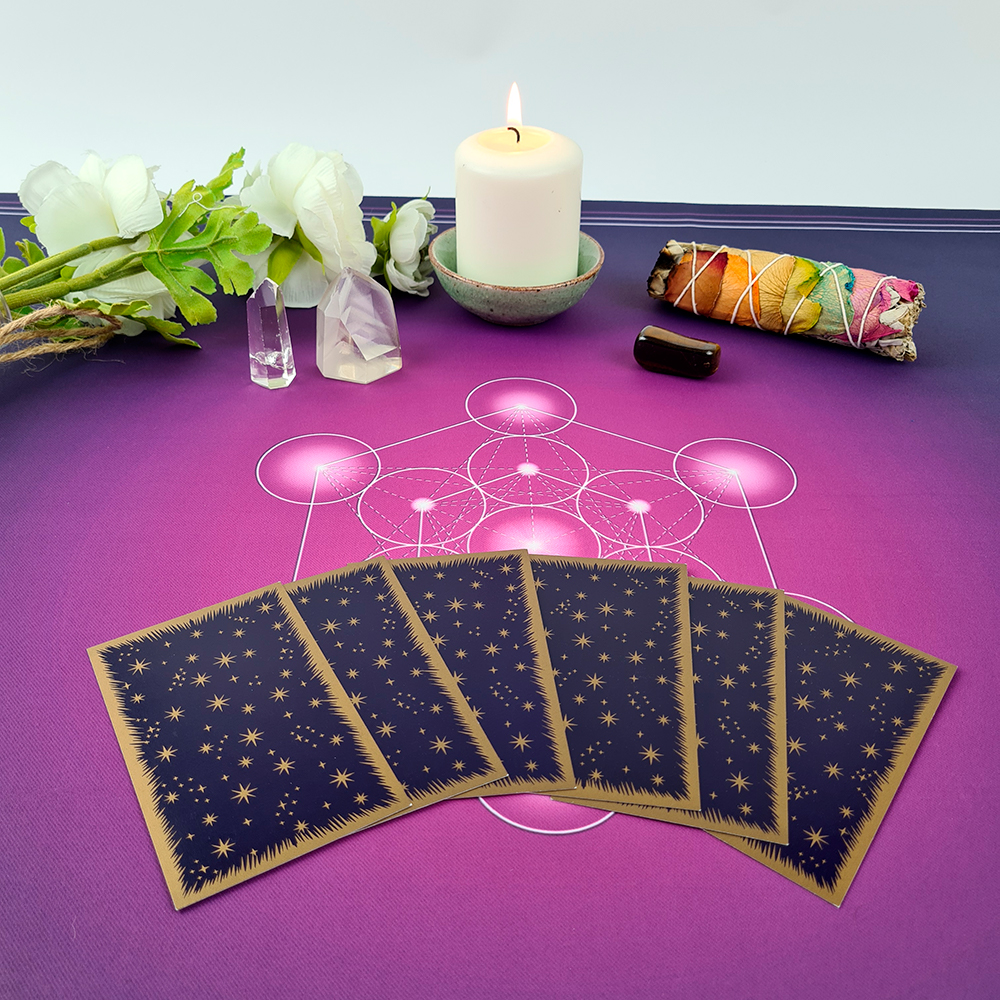
A tarot mat, in this context, isn't just there to "lay" the cards. It acts as a base, a support on which the draw can really be organized. It provides a boundary, a structure, something in which the reading can take place.
And when this support carries a symbol, something else happens.
The symbol is not decorative. It creates a center, landmarks, axes. The cards naturally fit into it and connect with it. Without you having to think about it, a form of order appears.
Reading becomes more stable. More coherent. More anchored.
The mat doesn't do the work for you. But it supports what's happening.
👉 If you want to feel this difference, you can simply start by choosing a tarot cloth that speaks to you, and see what it changes in your readings.
How to learn tarot cards reading differently (in the spirit of Wirth)
If we follow Oswald Wirth's approach, learning the tarot is not a matter of accumulating meanings, but of changing the way we look at it.
A symbol cannot be understood like a word. It cannot be translated immediately. It requires time, attention and a kind of familiarity. It's something you gradually tame, coming back to it, observing it from different angles, until something obvious emerges.
In concrete terms, this means slowing down.
Instead of looking for an answer, it's a matter of staying with the card. Really looking at it, letting the details emerge: a posture, a gesture, a direction, a repeating element. Little by little, links are formed, not because we've learned them, but because we perceive them.
And this perception evolves. The same map never says exactly the same thing. What you see changes, becomes clearer, more precise. Not because the map changes, but because your vision becomes more accurate.
Wirth insists on this point: you have to go back to the maps. Revisit them, let them work in you. It's in this repetition that understanding deepens.
And at some point, something shifts. You stop trying to interpret. You begin to recognize. From then on, you realize that the cards aren't just images. They are constructed, organized.
They are based on precise balances: between top and bottom, left and right, the center and what surrounds it. There are axes, correspondences, relationships that structure the image in depth.
And this is exactly what we find in sacred geometry. In a mandala, in a flower of life, in certain traditional figures, what gives meaning is not only the symbol itself, but the organization that supports it: proportions, symmetries, centers, circulations.

Tarot works the same way. It's as if each card were built on an invisible geometry, organizing what you perceive without you always being aware of it.
Each card is constructed as an organized form. And when you begin to perceive these structures, your reading changes. You no longer rely solely on meanings, but on coherence.
You're no longer looking at an image. You're entering an architecture.
In Omraam Mikhaël Aïvanhov's teachings, we are often reminded that symbols are not meant to be explained, but to be experienced. They don't provide an immediate answer. They open up a space.
And this is exactly what the tarot allows, when we accept to read it differently.
Reading cards is about creating space
At its core, tarot doesn't simply ask you to understand the cards. It invites you to look differently. To slow down, to observe, to let connections emerge rather than looking for immediate answers. Little by little, your reading changes. You're no longer looking for "what the card means", you're beginning to see what's going on.
And perhaps that's where everything becomes simpler. Because from then on, the question isn't really: what's the right meaning?
But rather:
👉 what do you see?
👉 what does the card set in motion?
👉 in what space do you let it appear?
Take a card, put it in front of you, and stay with it for a few moments. Don't try to come to a conclusion. Just look.
And if you feel like going further, I'd be curious to know:
👉 have you ever experienced a moment when a card "spoke" to you differently, without you really knowing why?
👉 or on the contrary, have you ever felt blocked in your readings?
You can share it in the comments. It's often in these exchanges that understanding really deepens.
We've come to the end of this article. I hope you enjoyed it.
Feel free to comment, share and subscribe to our newsletter to be informed of future releases.
Sources and inspirations
This article is based on the works and teachings of several authors who have deeply studied tarot as a symbolic language and a tool of knowledge.
Among them:
• Oswald Wirth – The Tarot of the Magicians
• Papus – The Tarot of the Bohemians
• Alejandro Jodorowsky – The Way of Tarot
• Omraam Mikhaël Aïvanhov – particularly his teachings on symbols and inner understanding
Reading tarot cards: their true meaning
How to work with symbols in everyday life
Hermes caduceus: origin, symbolism and misappropriation
Are we prisoners of our hormones?
No, not everything is a message from the universe