
David Hawkins' Map of Consciousness

Can we truly measure a person’s level of consciousness? Is it possible to associate an emotion, an attitude, or a way of perceiving the world with a “frequency” of consciousness?
This is the idea developed by David R. Hawkins through his famous map of consciousness, also known as the Scale of Consciousness,a model that associates different emotional and spiritual states with levels ranging from 1 to 1,000. Since its publication in *Power vs. Force*, this map of consciousness has sparked as much enthusiasm as it has debate. For some, it is a powerful tool for personal development. For others, it raises questions about its scientific foundations and the methodology used to develop it.
So, what is the Hawkins Map of Consciousness? How should we interpret the different levels of consciousness? Can we truly “raise our vibrational level” or measure our state of consciousness? And above all, how can we use this framework with discernment, without falling into oversimplifications or preconceived notions?
In this article, we invite you to explore the origins of David Hawkins’ scale, the meaning of each level of consciousness, the criticisms it has faced, and the insights it offers for the journey of self-discovery. We’ll also explore how certain practices, such as meditation or the contemplation of sacred symbols, can support an inner journey, without claiming to replace personal work.
In short:
David Hawkins' Map of Consciousness is a model proposed in the 1990s that classifies various emotional and spiritual states on a scale from 1 to 1,000. Although it is not recognized as a scientific measurement tool, it is widely used as a framework for reflection in the fields of personal development and spirituality.
What is the Hawkins Map of Consciousness?
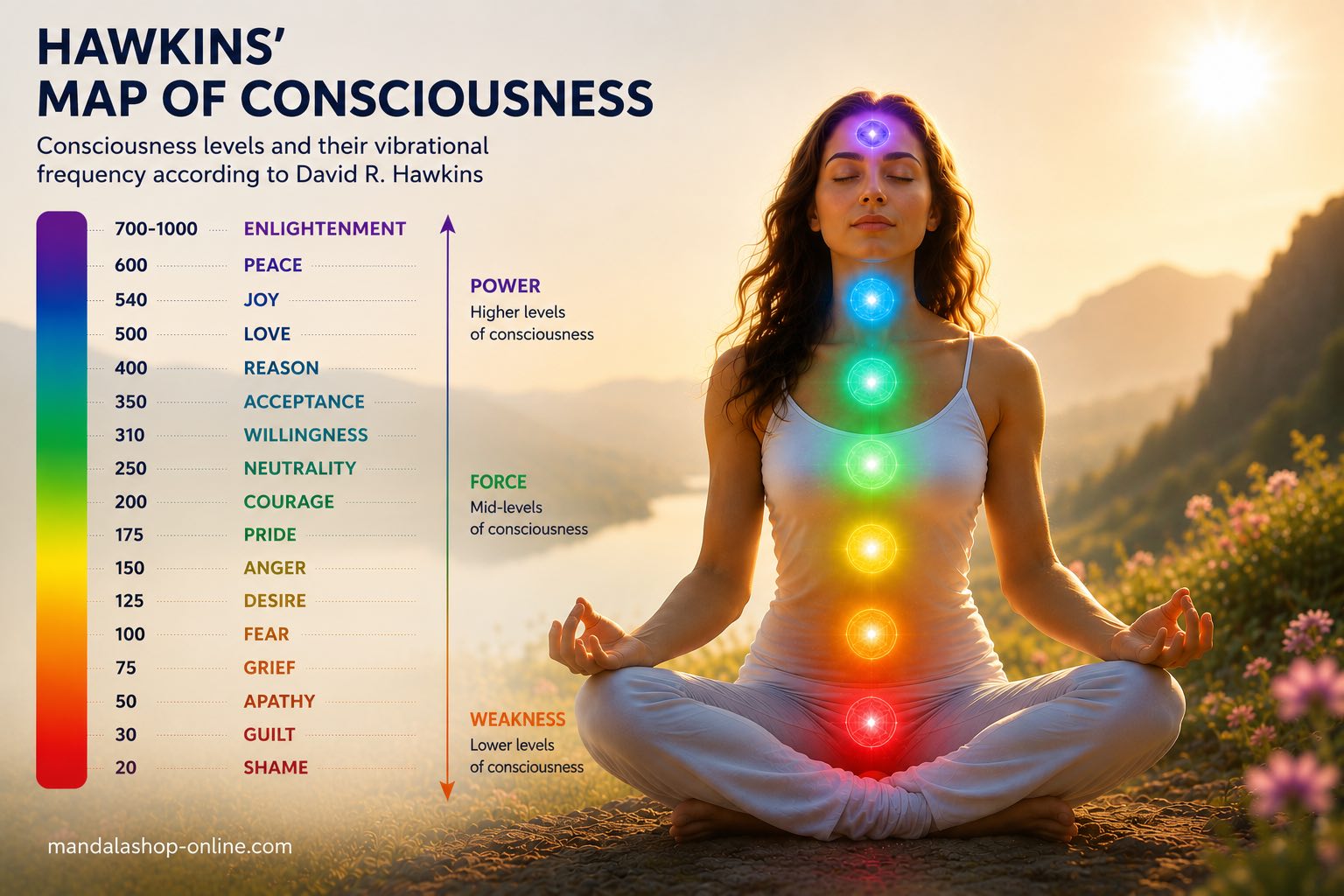
The Hawkins Map of Consciousness is a model proposed by American psychiatrist David R. Hawkins, which associates different emotional and spiritual states with a scale ranging from 1 to 1,000.
According to this approach, each level of consciousness reflects a particular way of perceiving the world, reacting to events, and interacting with others. Emotions such as shame, fear, or anger are found at the lower levels, while courage, love, joy, or peace correspond to the highest levels.
One of the best-known benchmarks on this scale is level 200, which Hawkins considers a threshold of transition between limiting states of consciousness and a more constructive dynamic focused on responsibility, trust, and personal growth.
The scale is generally presented as a table that associates each level with a dominant emotion, a worldview, and an inner state. It is now widely used in the fields of personal development and spirituality as a tool for reflecting on one’s personal journey.
Key Takeaway:
Hawkins’ map of consciousness provides a representation of the different states of consciousness, ranging from the most limiting emotions to states of peace and awakening.
Who is David Hawkins?
David R. Hawkins (1927–2012) was an American psychiatrist, physician, and educator known for his work on consciousness, personal development, and spirituality. After earning his medical degree, he practiced psychiatry for many years before turning his attention to the connections between psychology, emotions, and spiritual traditions.
Over the course of his career, David Hawkins developed a vision in which inner evolution can be understood through different levels of consciousness. This approach led to his most famous work, *Power vs. Force*, published in 1995. In this book, he introduced for the first time his famous map of consciousness, which maps emotional and spiritual states on a scale ranging from 1 to 1,000.
Hawkins subsequently expanded on these ideas in several books devoted to consciousness, letting go, and the spiritual quest, including *Letting Go* and *The Eye of the I*. His books have now been translated into many languages and continue to inspire readers around the world.
The originality of his work lies in his desire to bring together fields that are often studied separately: psychology, philosophy, the major spiritual traditions, and inner experience. This interdisciplinary approach largely explains the enduring popularity of the scale of consciousness, both among those engaged in personal development and in certain spiritual circles.
In the next chapter, we will see how David Hawkins claims to have developed this map and why his method continues to spark much debate today.
How did David Hawkins develop his map of consciousness?
To develop his map of consciousness, David Hawkins relied on a method he called “calibration of consciousness.” His goal was to assign a numerical value to emotions, ideas, works, personalities, and even states of consciousness.
According to Hawkins, these calibrations were based on muscle testing, a technique used in applied kinesiology. The principle is simple: when a person is presented with a statement, an object, or a thought, the tone of certain muscles changes depending on whether that information is beneficial or not to the body.
Hawkins believed that this reaction provided access to a level of consciousness deeper than the mind and that it was thus possible to determine a level of consciousness on a scale ranging from 1 to 1,000.
Using this method, he assigned a calibration level to numerous emotional states. For example, shame would be rated at 20, fear at 100, courage at 200, love at 500, and peace at 600. He also applied this approach to religious texts, philosophies, historical events, and certain spiritual figures.
For David Hawkins, this map described not only emotions but also the way a person perceives the world and reacts to their environment. The higher the level of consciousness, the more the individual is guided by qualities such as responsibility, compassion, serenity, or love.
This method has greatly contributed to the popularity of the consciousness map, but it is also the source of the many discussions it has sparked. We will explore this in the next chapter.
Is the Consciousness Map scientifically recognized?
No. To date, David Hawkins’ map of consciousness is not recognized as a validated scientific model.
The main reason lies in the method used to develop this scale. Hawkins’ calibrations are based on muscle testing derived from applied kinesiology, an approach whose reliability has not been demonstrated according to the criteria of scientific research.
This does not mean that his work is without merit. Many people use the consciousness scale as a framework for personal development, allowing them to reflect on their emotions, behaviors, and inner growth, without viewing it as an objective measurement tool.
At Mandalashop, we prefer to take a nuanced approach. Hawkins’ map can be a source of inspiration and encourage introspection, provided it is not viewed as an absolute truth or a means of categorizing individuals. Beyond the numbers, it invites us above all to reflect on how we experience events and the emotions we choose to nurture in our daily lives.
Levels of Consciousness Explained
According to David Hawkins, our state of consciousness influences how we perceive the world, make decisions, and relate to others. His scale does not describe fixed categories of people, but rather different inner states that everyone can experience throughout their lives.
Levels of consciousness are generally grouped into three main phases: states dominated by limiting emotions, the tipping point of courage, and states of expanded consciousness.
| Level | Emotion | Keyword | Possible development |
| 20 | Shame | Self-deprecation | Regain self-esteem |
| 30 | Guilt | Remorse | Acceptance and Forgiveness |
| 50 | Apathy | Resignation | Regain Momentum |
| 75 | Grief | Loss | Accept |
| 100 | Fear | Insecurity | Build confidence |
| 125 | Desire | Lack | Cultivating Detachment |
| 150 | Anger | Reaction | Transforming Energy |
| 175 | Pride | Comparison | Developing Humility |
| 200 | Courage | Action | Daring to Move Forward |
| 250 | Neutrality | Balance | Take a Step Back |
| 310 | Goodwill | Openness | Learning |
| 350 | Acceptance | Responsibility | Acting Consciously |
| 400 | Reason | Understanding | Seeking the truth |
| 500 | Love | Compassion | Unconditional Love |
| 540 | Joy | Serenity | Radiate |
| 600 | Peace | Unity | Live Life to the Fullest |
| 700–1,000 | Awakening | Consciousness | Transcendence |
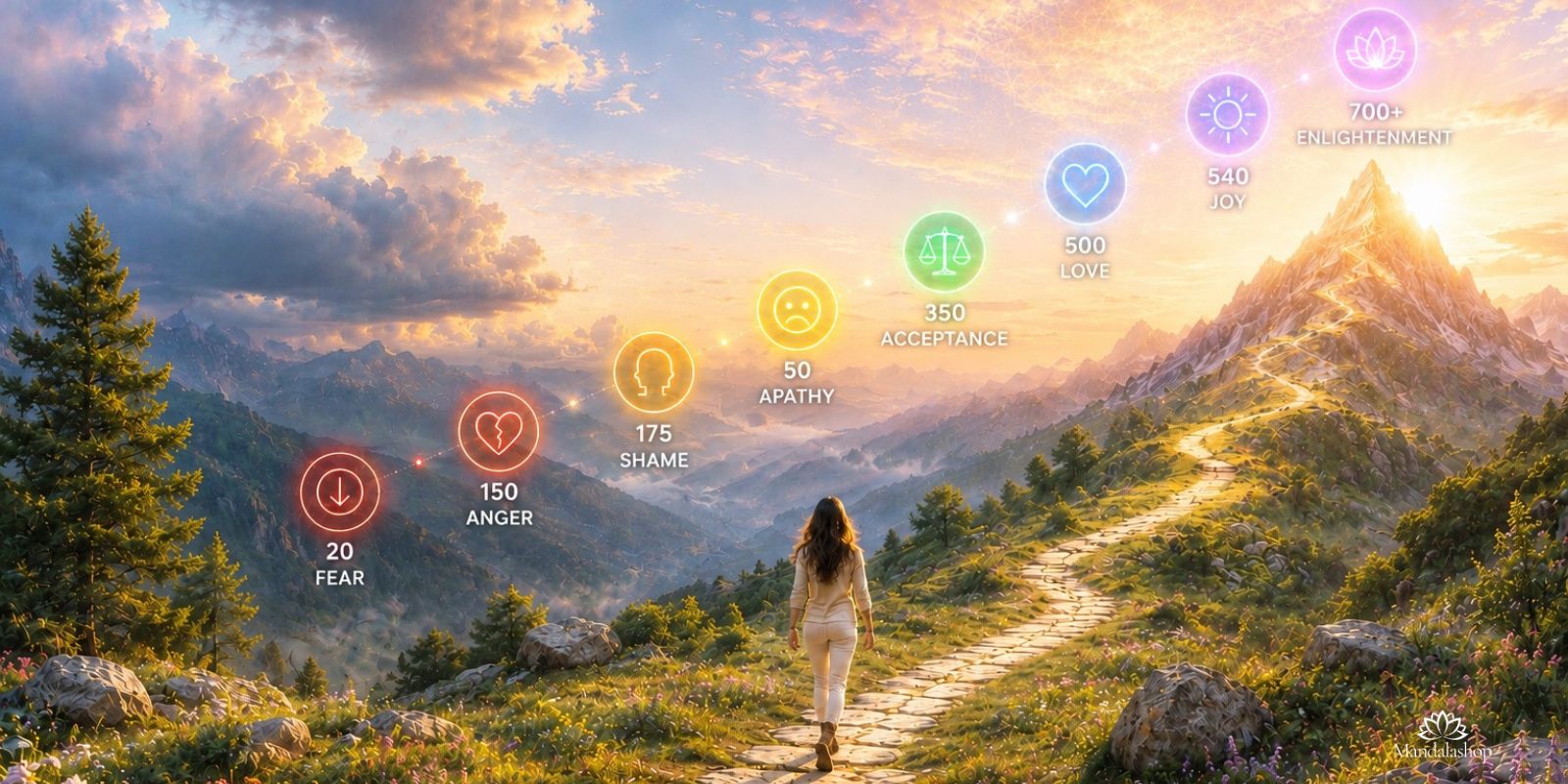
Emotions That Limit Us (20 to 175)
The first levels of the map correspond to emotions that consume a large portion of our energy. They are often linked to fear, lack, or a sense of separation.
At these levels, life is primarily experienced through difficulties, wounds, or threats. Reactions are guided more by automatic responses than by conscious choices.
20 – Shame: The person experiences a deep sense of worthlessness. They may feel they do not deserve to be loved or have a place in the world.
30 – Guilt: Regrets, remorse, and self-criticism take center stage. It becomes difficult to move forward with peace of mind.
50 – Apathy: This is the stage of discouragement and resignation. Everything seems to require a considerable effort, and the future appears bleak.
75 – Grief: a loss, bereavement, or emotional suffering takes center stage. Energy is focused on what is gone rather than on what remains possible.
100 – Fear: the world is perceived as unpredictable or threatening. Safety becomes a constant concern.
125 – Desire: Happiness seems to depend on obtaining something: a relationship, an object, success, or external recognition.
150 – Anger: Often perceived negatively, anger nevertheless represents a more dynamic energy than fear. It can lead to conflict, but it can also become a driving force for transformation when channeled properly.
175 – Pride: This level provides a certain degree of self-confidence, but this confidence is often based on comparisons with others, success, or the need to maintain one’s image.
These levels should not be interpreted as judgments. We all go through periods of fear, anger, sadness, or doubt at different times in our lives. The value of this reading lies more in raising awareness than in seeking a label.
Level 200: The Turning Point on the Map of Consciousness
Among all the levels on David Hawkins’ map of consciousness, Level 200—associated with courage—holds a special place. According to Hawkins, it marks a transition from emotions that limit our ability to act to a more constructive attitude focused on personal growth.
Below this threshold, emotions such as fear, guilt, or anger can influence how we perceive events and respond to challenges. Starting at Level 200, courage enables us to approach situations with greater confidence and responsibility.
Courage does not mean the absence of fear. Rather, it corresponds to the ability to move forward despite uncertainties, to learn from one’s experiences, and to accept that change is part of the journey.
This is why David Hawkins considers this level a tipping point. It symbolizes the transition from a mindset where one is largely at the mercy of events to an approach where one gradually becomes the architect of one’s own evolution.
It is important to keep in mind, however, that this boundary remains symbolic. We all experience different emotional states depending on our circumstances, and no one remains permanently at the same level of consciousness. Rather than a goal to be achieved, Level 200 can be seen as an invitation to move forward, one step at a time, toward greater self-awareness.

Levels of Expansion of Consciousness (250 to 600)
Above the level of courage, emotions gradually become calmer and one’s perception of the world evolves.
250 – Neutrality: situations are approached with greater detachment. Conflicts lose their importance, and differences are more readily accepted.
310 – Goodwill: The desire to learn, grow, and contribute takes precedence. Curiosity gradually replaces resistance.
350 – Acceptance: Unlike resignation, acceptance involves recognizing reality as it is in order to act more effectively.
400 – Reason: Understanding, analysis, and the search for truth take center stage. The mind becomes more objective and structured.
500 – Love: This does not refer to romantic attachment, but rather to a state of kindness, compassion, and openness toward others.
540 – Joy: A lasting inner peace takes hold, less dependent on external circumstances.
600 – Peace: According to Hawkins, this state corresponds to a deep serenity, characterized by a sense of oneness with life.
As consciousness rises, impulsive reactions gradually give way to greater perspective, understanding, and trust.
States of Awakening (700 to 1000)
The highest levels on the scale represent what David Hawkins describes as states of spiritual awakening.
These are said to be extremely rare and correspond to a state of consciousness in which the sense of separation between oneself and the world gradually disappears. Hawkins associates these levels with great spiritual figures who have profoundly shaped the history of humanity.
It is important to note, however, that these values are based on his own model and do not constitute objective measurements.
A Continuum Rather Than a Ranking
The map of consciousness is sometimes interpreted as a ranking among individuals. However, that is not how David Hawkins presented it.
In the course of a single day, we can move from frustration to gratitude, from fear to trust, or from anger to serenity. Our inner states are constantly evolving based on our experiences, our environment, and the work we do on ourselves.
At Mandalashop, we prefer to view this map as an invitation to observe our emotions with greater awareness rather than as a measure of our self-worth. Every emotion can become an opportunity to get to know ourselves better and to move forward, step by step, on our own path of transformation.
How can you use the consciousness map in your daily life?
David Hawkins’ Map of Consciousness can be used as a tool for self-reflection rather than as a way to rate yourself or compare yourself to others. Its value lies less in identifying a specific level than in observing the emotions we experience.
When faced with a difficult situation, it can be helpful to ask yourself: Which emotion is dominant right now? Is it fear, anger, discouragement… or, on the contrary, confidence, acceptance, or serenity? This simple act of awareness often allows us to step back and avoid reacting automatically.
The map also reminds us that our emotional states are not fixed. We can move through several levels of awareness in the course of a single day, depending on the events we experience. It is therefore pointless to try to define ourselves by a number or to strive at all costs to reach a high level.
The key is to view each emotion as a form of information. Even uncomfortable emotions serve a purpose: they highlight a need, a wound, or a situation that deserves our attention. Welcoming them with kindness is often the first step toward inner transformation.
Ultimately, the Hawkins Map can be seen as an invitation to develop greater self-awareness. It encourages us to observe our reactions, cultivate greater presence, and move, step by step, toward more peaceful and mindful states.

Can symbols guide an inner journey?
For millennia, symbols have played an important role in many spiritual and philosophical traditions. Whether it’s the Flower of Life, the Sri Yantra, the Tree of Life, the Metatron Cube, or the mandala, all have been used as tools for meditation, contemplation, or inner reflection.
Observing a symbol, meditating with it, or wearing it as a reminder of an intention can help us refocus, calm the mind, and encourage a more mindful presence within ourselves. From this perspective, the symbol does not act on our behalf; rather, it accompanies a personal journey.
This perspective also aligns with the spirit of David Hawkins’ Map of Consciousness. While inner growth depends above all on how we experience life and the choices we make each day, certain tools can help us cultivate states such as calm, gratitude, trust, or compassion.
At Mandalashop, we view symbols as companions on our journey. They are not meant to transform a person on their own, but can serve as reminders of an intention, support a meditative practice, or invite us to return to the present moment. It is this personal relationship with the symbol that gives it its full meaning.
If you'd like to incorporate these symbols into your daily practice, take a look at some of the designs we've selected to accompany your moments of meditation, introspection, or refocusing.


What is the difference between the Hawkins Scale and the Bovis Scale?
You may be wondering if there’s a connection between David Hawkins’s Scale and the Bovis Scale. After all, both use numerical values and are often discussed in the fields of personal development, spirituality, and energy practices. However, they are based on very different approaches.
David Hawkins’ map seeks to represent states of consciousness. Each level corresponds to an emotion or a way of perceiving the world, ranging from shame to spiritual awakening. His approach is rooted in a philosophical and spiritual reflection on inner evolution.
The Bovis scale, on the other hand, is used in dowsing to estimate what some call the energy level or vibrational frequency of a person, a place, or an object, typically using a pendulum and a graduated dial.
Although both models use numbers, they do not describe the same reality. One focuses on states of consciousness and emotions, while the other focuses on an energetic concept specific to dowsing practices.
If your goal is to improve your daily well-being rather than to measure a specific level, you may also want to check out our article on 7 ways to raise your vibrational frequency. There, you’ll find practical tips for cultivating positive emotions, regaining a better inner balance, and nourishing your energy every day.
| Criterion | Hawkins Scale | Bovis Scale |
| Objective | To represent states of consciousness and emotions | To estimate the energy level (or “vibrational frequency”) of a living being, a place, or an object |
| Field of Application | Personal development and spirituality | Dowsing and energy practices |
| What is assessed | Consciousness, emotions, and perception of the world | The subtle energy of a person, an object, or an environment |
| Method Used | Muscle testing (applied kinesiology) | Pendulum and Bovis dial |
| Scale | From 20 to 1,000 (and beyond for certain spiritual states) | Generally expressed in Bovis units, with no universal limit |
Last words
David Hawkins’ map of Consciousness continues to spark interest among many people seeking personal growth and spirituality. While its scientific foundations are debated, it offers a framework that invites us to take a closer look at our emotions, our reactions, and our way of being in the world.
Ultimately, perhaps the most important thing is not to try to determine one’s “level of consciousness,” but to cultivate a more mindful presence in daily life. Every experience—whether pleasant or difficult—can become an opportunity to learn, grow, and evolve.
Symbols, meditation, contemplation, or any other practice that promotes centering can support this journey. Not by transforming who we are, but by reminding us of the importance of returning to what matters most: self-knowledge, an open heart, and the ability to move forward with greater serenity.
And you—what are your thoughts on David Hawkins’ Map of Consciousness? Were you familiar with it? Do you view it as simply a tool for reflection, a source of inspiration for your inner journey, or do you have some reservations about this approach?
Share your perspective in the comments. Your experiences, questions, and reflections often enrich the conversation and allow everyone to explore this topic with greater openness and discernment.
Feel free to comment, share, and subscribe to our newsletter to stay informed about upcoming posts and learn more about symbols!
Further Reading (Works by David R. Hawkins)
Power vs. Force: The Hidden Determinants of Human Behavior (1995) – The seminal work in which David R. Hawkins first presents his famous map of consciousness.
Transcending the Levels of Consciousness (2006) – An in-depth exploration of the different levels of consciousness and their significance on the spiritual path.
Letting Go: The Pathway of Surrender (2012) – A book focused on letting go and how to embrace emotions in everyday life.


 Samhain: What Does the Dark Season Really Reveal?
 Viking Symbols: Myths, Mysteries, and Truths
 Spiritual tattoo: do tattoos really have an effect?

Mandalashop - 09/23/2026 08:43:23
Bonjour Marc, Merci d'avoir pris le temps de partager votre réflexion ! Vous soulevez un point intéressant : l'apathie peut effectivement se manifester à différents degrés, allant d'un simple manque d'élan à un état de détachement beaucoup plus profond. C'est aussi ce qui nous invite à prendre du recul sur l'échelle de Hawkins. Peut-on réellement classer des états intérieurs aussi complexes selon une hiérarchie précise ? Chaque personne vit ses émotions et ses expériences à sa manière, et aucune échelle ne peut véritablement rendre compte de toute cette richesse. Merci encore pour votre contribution à cette réflexion. Véronique
Marc - 09/22/2026 11:53:56
Bonjour. Un commentaire qui n’engage que moi concernant cette échelle de Hawkins. A propos de l’apathie, que je considère au plus bas de l’échelle de conscience. L’Apathie en elle-même peut se voire avec une propre échelle de valeur, de légère à quasi-totale. L’Apathie totale ne serait qu’une déconnexion totale avec le monde extérieur, y compris soi-même. La personne ne ressent plus rien, ne voie plus rien, ne répond et ne réagit à rien. Aucune émotion. Donc, pas plus de culpabilité que de quoi que se soit… Merci à vous. Marc, un modeste client…