
The Octagon: Symbol of Divine Justice and Balance

The octagon isn't just a geometric shape. It's a passageway. Between the square of matter and the circle of the divine, it links the visible and the invisible. Few symbols unite heaven and earth, the ephemeral and the eternal to such an extent.
It can be found in temples, mosaics, baptisteries, mandalas and zelliges. Wherever man has sought to embody light in matter, the octagon has appeared as a key.
In the language of sacred geometry, it is the bridge between two worlds: the square, figure of earthly stability, and the circle, image of the infinite sky. As René Guénon wrote, every intermediate form between the square and the circle represents a state of passage - a space of transmutation.
The number eight, for its part, speaks of balance, harmony and resurrection. It is the number of divine justice, which does not judge, but restores righteousness. Upright, the eight symbolizes the verticality of the manifest world; lying down, it becomes the sign of infinity, the uninterrupted breath of life.
The number eight: the vibration of divine justice
In the initiatory tradition, the number eight is the cipher of cosmic justice, uniting forces without opposing them. It does not separate good from evil, but re-establishes order between them.
It excludes nothing: it harmonizes.
Eight does not judge - it balances.
It represents that moment when descending and ascending energy become equalized, when the force of matter is married to the light of spirit. This is the state of absolute equilibrium that the ancients called divine rightness, the inner alignment that makes the law of heaven and the law of the heart coincide.
Beneath its apparent simplicity, the figure eight contains two mirrored spheres: one terrestrial, the other celestial. Their point of contact is the center - that still space where pure consciousness manifests itself. This is why traditions often associate the figure eight with the presence of Archangel Michael, guardian of ordered light.
His justice does not destroy: it enlightens.
It does not punish: it restores harmony.
In this blue fire of balance, opposites are resolved without violence.
The figure eight acts as a universal principle of adjustment: everything that deviates from the center eventually returns to it. This is the law of karma in its highest form - not punitive, but educational. Every experience brings us back to measure, to the rightness of the heart, until peace naturally settles in.
What's the difference between the Octagon and the Hexagram?
It's interesting to compare the octagon with the hexagram symbol, often referred to as Solomon's Seal.
The hexagram, formed by two intertwined triangles, represents the balance between microcosm and macrocosm: the meeting of fire and water, masculine and feminine, spirit and matter. Its movement is vertical: it expresses the union of opposite poles, the exchange between up and down.
But the octagon goes further.
Where the hexagram connects, the octagon stabilizes. It symbolizes not just a meeting, but the integration of forces into a structure of peace. It is a geometry of embodied equilibrium, that of divine justice in action.
The hexagram sets in motion; the octagon fixes movement in order. The former evokes the alchemical process - the fusion of opposites - while the latter manifests the accomplished state, the transfigured world.
It could be said that the hexagram is the dynamic of union, and the octagon is the luminous repose of this realized union. It is the inner chamber where fire and water have married to become light.
Thus, the hexagram is the work, the octagon is the result. One teaches us how to balance our polarities, the other how to remain in the peace of the center. This is the difference between the balance achieved by the tension of opposites and the stable equilibrium of the enlightened heart.
From this perspective, the octagon appears as the seal of divine justice fulfilled: peace after struggle, light after fusion, stability after movement.
The geometric language of passage
Geometry is not a cold science: it's the language of creation. Every visible form is the signature of an invisible force. It is at once letter, note and vibration in the great alphabet of the world.
The octagon fits into this divine grammar as a form of passage, a sacred threshold between two states: matter and spirit, square and circle, earthly and celestial. It acts as a living intermediary, a bridge of energy where consciousness flows freely from one plane to another.
In this perspective, Éliphas Lévi - one of the greatest initiates of the XIXᵉ century - recalled that every geometric figure is a talisman, a condensed intelligence. He wrote:
"Figures, letters and signs are the visible expressions of invisible forces. He who understands them possesses the key to the worlds." (Dogme et rituel de la haute magie)
The octagon, as a figure of eight, expresses this magical harmony between spirit and matter, this divine rhythm underlying all manifestation.
For Lévi, true magic is that which restores order in chaos, which brings the light of the Word down into substance. And this is precisely the role of the octagon: to order the world without freezing it, to channel light without constraining it.
The bridge between the square and the circle
The square is the base, the earth, the reign of form and law. It symbolizes the four elements, the four directions, the four pillars of the manifest world. It is the structure, the limit, the stability necessary to all incarnation.
The circle, on the other hand, is the symbol of heaven, of spirit, of eternal movement. It has no beginning and no end: it represents perfection, unity and wholeness. To find out more about the meaning of the circle, please read my dedicated article.
Between these two poles, the octagon acts as a mediator. It is the path of the golden mean, the gateway to initiation, the shape of passage. It reconciles square and circle, law and grace, structure and fluidity.
In ancient temples, this passage was expressed physically: octagonal baptisteries symbolized the passage from the old man to the new man. The figure eight represented spiritual regeneration, the passing of the seven-day cycle. As Lévi put it, "initiation is the passage from law to freedom, from number to spirit" - and the octagon is the very geometry of this passage.
The octagon as a talisman of balance
Lévi taught that true magic is a science of balance: the balance of forces, opposites and planes. Every imbalance generates suffering; every conscious balance generates light. This is why he placed justice, the virtue of the eight, at the center of his symbolic system.
" Justice is the key to life and the world. It alone makes the wheel turn without breaking the center" (The Key to the Great Mysteries)
The octagon is this stable wheel: eight spokes starting from the same center, eight paths leading back to unity. It teaches self-mastery, respect for the laws of the cosmos and the gentleness of the heart that understands these laws. It is not just a figure to be contemplated, but an operative talisman, a diagram of transformation.
When we meditate on this form, we place ourselves at the center of this wheel of justice.
We become that immobile axis around which everything can turn without shaking us. This is the secret of true serenity: to remain at the center, regardless of the forces in motion around us.
A universal architecture
In all civilizations, ancient wisdom has translated this truth into stone and light.
The builders of medieval cathedrals, inspired by hermetic science, constructed octagonal spaces to represent the passage from earth to heaven. In Islamic temples, the octagon serves as a transition between the square ground plane and the spherical dome, the image of heaven.
And even in Eastern mandalas, we find this eight-directional structure, the point of union between the world of forms and that of emptiness.
The octagon is thus universal: it speaks the same language in all traditions. It is the symbol of the transfigured world, of the square turned into a circle, of matter illuminated by spirit.
Eliphas Levi is quoted as saying that this is where the real magic lies: "To make the visible the garment of the invisible, and the earthly the throne of the heavenly."
The symbol of man between heaven and earth
The octagon is not just a stone figure or a line of ancient parchment: it's a living archetype of the human being. It represents the sacred tension between two dimensions: the weight of matter and the momentum of spirit, anchorage and elevation, limit and infinity.
Man, in his deepest structure, is himself a living geometry. His body belongs to the square - to the world of the four elements, to gravity, to the law of time. But his soul tends towards the circle - towards the divine, towards light, towards perfection. Between the two, he must build his own inner octagon: a space of balance, peace and consciousness where these two realities unite without fighting each other.
Man: temple of sacred geometry
In initiatory science, man is described as a universal temple, a replica of the cosmos in miniature. Every organ, every function, every movement corresponds to a cosmic force, a star, a law of creation. Éliphas Lévi said that "man is the microcosm, the faithful mirror of the macrocosm" - and it is through consciousness that he can harmonize these two worlds.
This harmony is not given: it is built, like an inner cathedral. And that's where the octagon comes in. It is the plan of the inner temple, the invisible framework that links the four directions of the material world to the four spiritual directions. Its eight sides are the eight pillars of human consciousness: enlightenment, prudence, respect, discipline, love, harmony, eternity and justice.
Every time man cultivates one of these virtues, he erects within himself a section of this luminous temple. And when they all vibrate together, they form a space of clarity where the divine can dwell.
The bridge between the two kingdoms
In the teachings of spiritual masters, man is described as a living bridge. He is the one who links the kingdoms - mineral, vegetable, animal and divine - by unifying them in his consciousness. But for this bridge to be solid, it must be built according to the law of sacred geometry: in other words, in the right way.
Omraam Mikhaël Aïvanhov often spoke of this balance to be maintained between high and low: man must neither flee into the spiritual, nor lose himself in matter. He must unite the two. This is precisely what the octagon teaches us: to remain at the center, breathing between the human and the divine, between earthly law and celestial light.
Man is therefore not a being separated from the cosmos: he is its beating heart. He contains within him the same forces that animate stars and stones, trees and angels. And it's when he becomes aware of this that he becomes a true agent of universal harmony.
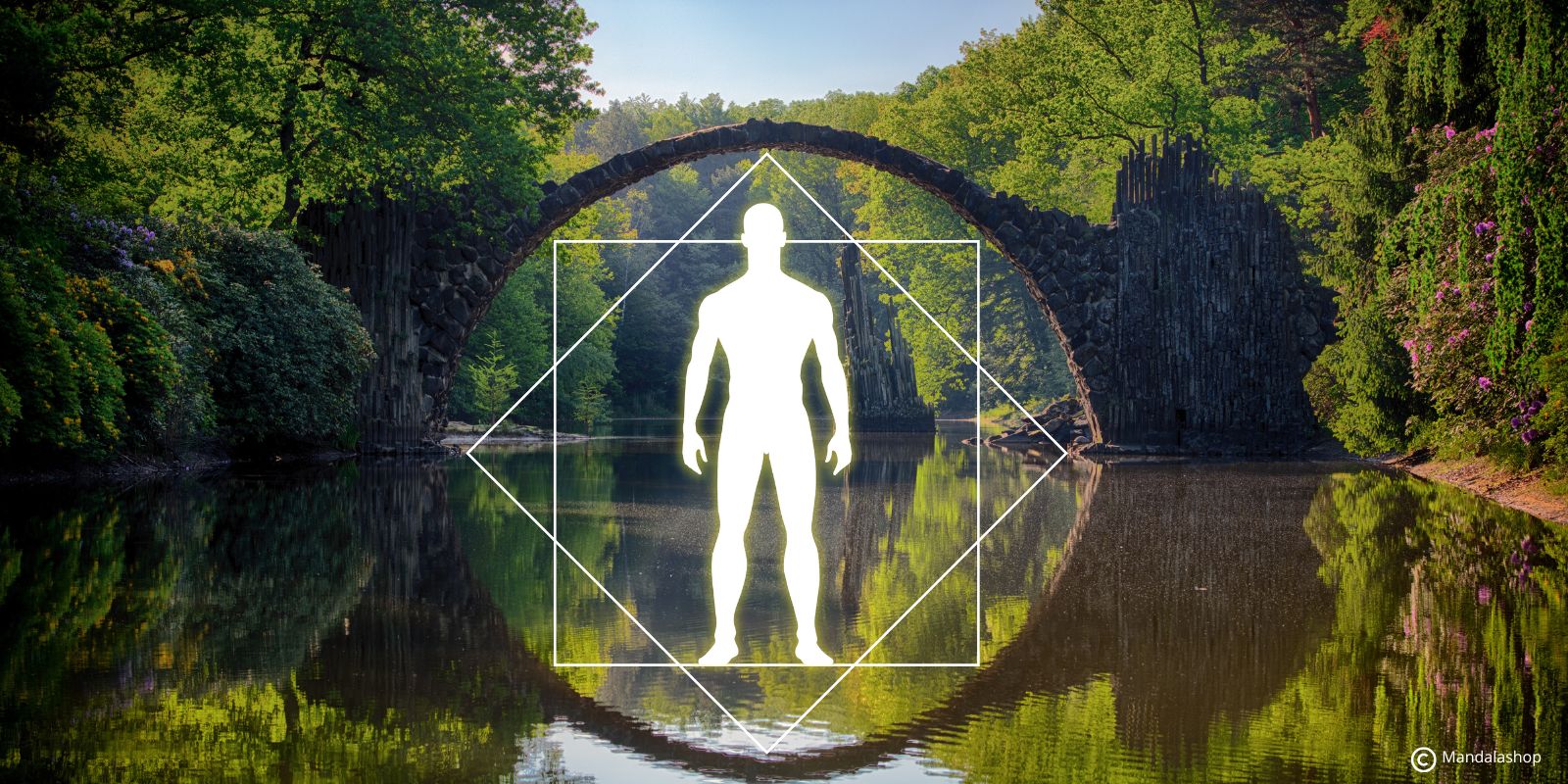
The balanced man: mirror of the world
Eliphas Levi wrote: "The just man is the center of the universal balance; he tips the world to the side of light
This sentence alone sums up the initiatory function of the octagon. A man who attunes himself to his inner center becomes an axis of stability for everything around him. He is no longer subject to the fluctuations of the world, for he lives according to the geometry of the eight - this breathing between two poles, where each extreme nourishes the other.
In spiritual terms, this means that true power lies not in domination, but in mastery; that true light lies not in upward flight, but in the ability to illuminate matter itself.
The octagonal man - so to speak - is the one who has reconciled the opposites within himself. No longer torn between heaven and earth, he brings them into dialogue. He becomes what the ancients called the righteous one, whose very presence balances the world.
The octagon as the matrix of the new man
In many traditions, the octagon symbolizes resurrection or new birth. It's not just the passage from death to life, but from ignorance to awareness, from disorder to harmony. It's the birth of the true man - the one who lives according to the law of eight, that is, according to the divine order inscribed in matter.
This transformation doesn't happen overnight. It requires patient work, an inner alchemy. Each time man chooses clarity over confusion, measure over excess, peace over struggle, he adds a stone to his octagonal temple. Little by little, he himself becomes this passageway: a living bridge between the visible and the invisible.
In this way, the octagon is more than just a symbol: it's a path of initiation, a model of human transformation. It reminds us that we carry within us the structure of the world, and that by harmonizing our own forces, we contribute to the balance of the entire universe.
Drawing the octagon: a geometry of light and inner justice
To draw an octagon is to participate in an act of conscious creation. Each line, each angle, each breath becomes a sacred movement, a correspondence between human gesture and divine order.
In the initiatory tradition, geometry is not an abstract science, but an art of communion.
We don't draw to draw: we draw to understand, to connect, to invoke an idea.
In this way, compass, ruler and pencil become instruments of silent prayer, tools of transmutation.

On a blank sheet of paper, start by drawing a circle. This circle represents the divine world, perfection, the limitless spirit. It is the celestial sphere, the model for all creation.
Inside this circle, draw two diameters perpendicular to each other, forming a cross. This gives you four cardinal points - the foundations of matter, the invisible square.
Then connect the intermediate points between each end of the cross.
The result is eight equal divisions of the circle: the structure of the octagon appears.
Now connect these eight points.
Each line must be drawn with intention and care, for it evokes a living quality of the soul.
The drawing takes shape slowly, harmoniously, as if light were inscribing itself into matter.
According to spiritual tradition, each of the eight lines of the octagon corresponds to a virtue, a stage, a force of balance to be awakened:
- Awakening - the first line, the one that opens consciousness. It reminds us of our responsibility in creation.
- Prudence - inner vigilance, the discernment that precedes right action.
- Respect - recognition of life in all its forms.
- Discipline - the order we give ourselves in order to be free.
- Love - the warmth that unites without possessing, the driving force behind all creation.
- Harmony - the right balance between giving and receiving, acting and contemplating.
- Eternity - awareness of the cycle, the breath that links all worlds.
- Justice - the supreme point of balance, the mirror of divine will in the human being.
These eight virtues, traced like a circuit, become a living mandala. As the hand traces them, consciousness awakens them. Together, they form a structure of order and beauty in which the soul can recognize itself.
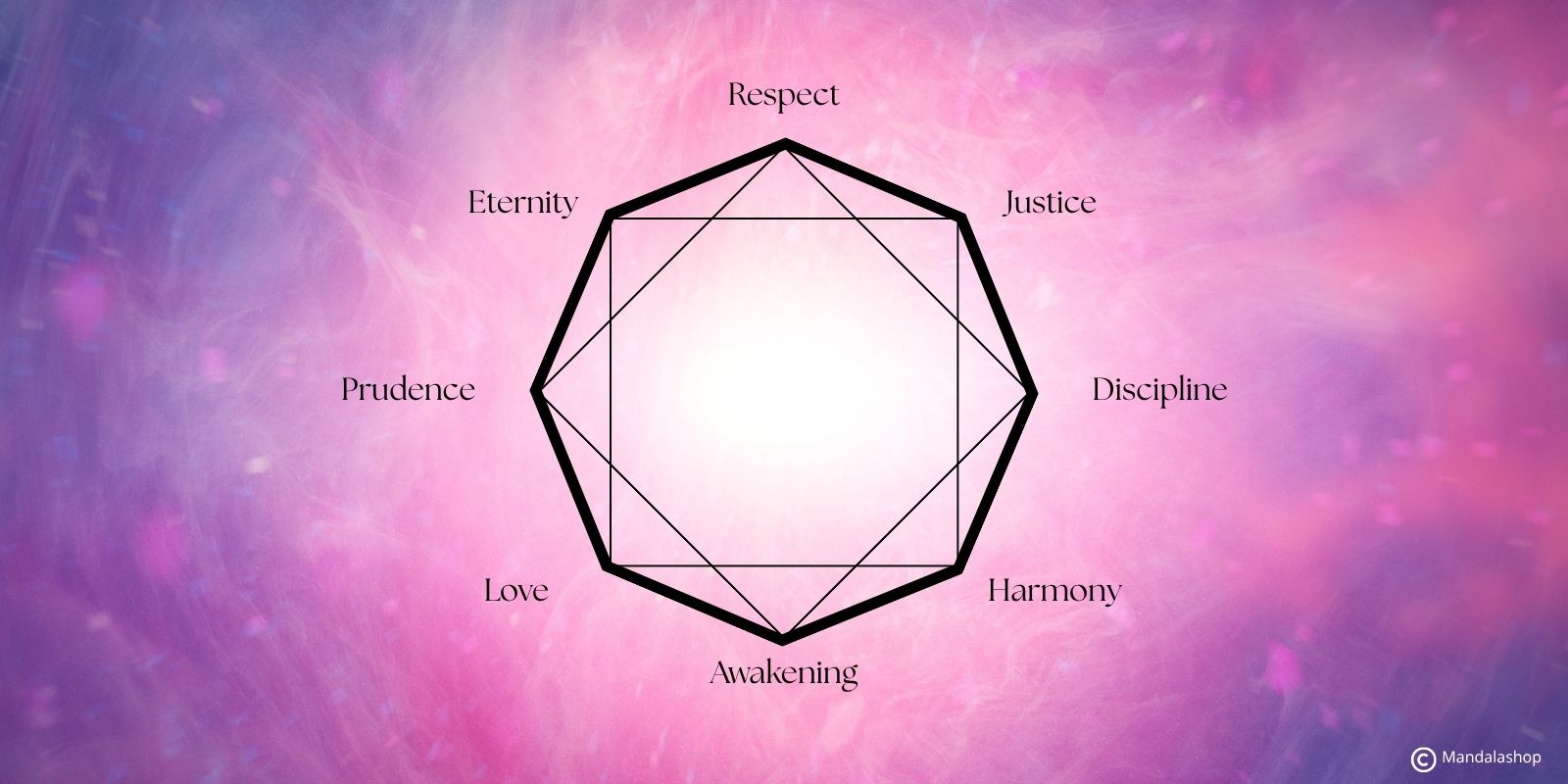
The inner temple
In the silence of this gesture, something happens. Mind, hand and form come together with the same intention: to bring order to chaos. What we draw on paper becomes part of our own vibratory field. Every straight line becomes a line of force in our inner world.
The circle, which began as a simple outline, becomes a sacred space. It now harbors a new order: that of the figure eight, symbol of regeneration. The man who consciously traces the octagon rebuilds his own inner temple, stone by stone, line by line. It's no longer a drawing, but a magical act in the purest sense: linking human will with divine intelligence.
Eliphas Levi wrote that "conscious geometric tracing is the very writing of light on matter". By drawing the octagon, we learn to write light in our own lives.
Each right angle recalls the firmness necessary for truth, each diagonal the flexibility of the heart, and each side the responsibility of holding these two forces together.
Meditative practice
To enter fully into this experience, settle into a state of calm. Breathe deeply. Set your intention: I draw to balance, I draw to illuminate, I draw to unite.
As you draw, associate your breathing with the gesture:
- Inhale as you draw the line (reception),
- Exhale as you bring it back down (giving).
The octagon then becomes a cosmic breath. Each inhalation calls forth light, each exhalation anchors it in matter. The line becomes a silent prayer, a dialogue with divine geometry.
The space of the center
When the figure is finished, look at its center. This is the point of perfect immobility, the invisible heart of the world. Here, all forces come together without canceling each other out. It's the peace of eight, justice in action.
This center corresponds to what the masters call the inner sanctum - the place where human consciousness meets the divine presence. This is where Michael, symbol of clarity and rectitude, stands in silence. He doesn't judge, he enlightens. And in this light, geometric form fades away: all that remains is the pure vibration of balance.
To draw an octagon is to order one's own universe. It's a reminder to matter that it belongs to light, and to consciousness that it's its duty to harmonize the world. It's a geometrician's prayer, an artist's and magician's act, a peace ritual.
And when the figure is complete, when the hand stops and the gaze rests on the center, there is a great silence. A vibrant, full silence that says: heaven and earth are no longer two - they breathe together.
The inner fire of living justice
The octagon is not just a symbol to contemplate; it's a path to follow. Those who study it in depth will discover that it speaks not only of the world - it speaks of us.
It reveals the structure of our being, the invisible geometry of our soul.
At the center of this shape burns a fire: the fire of inner justice, that which does not condemn, but enlightens. It's a calm, clear, orderly fire. It destroys nothing: it purifies, putting everything back in its place. It is this fire that Archangel Michael holds in his hand, this blue flame that separates light from shadow, not to oppose them, but to reveal their rightful place in the great balance.
True justice is not measured in words or laws, but in inner light. It begins when the human being ceases to seek perfection on the outside and lights the flame within. Then he understands that every trial is an opportunity to adjust, to purify, to learn to love without weakness and to act without harshness.
The octagon teaches us this sacred science of measure. It teaches us that peace comes not from the absence of conflict, but from the presence of a center - that still point within us where the fire of heaven and the matter of earth unite in the same clarity. This is where true justice lies: the justice that makes the human being a pillar of balance between the worlds.
When this fire awakens, it enlightens without burning, it orders without constraining, it transforms without destroying. It becomes the tranquil light of those who have understood, not through reason but through life, that everything in the universe obeys a geometry of love.
And perhaps this is the secret message of the octagon: to be just is to be at peace with the light. It means becoming a living temple where the flame of heaven finally finds its home in matter.
If this article has awakened something in you, don't hesitate to share it or leave a comment. Every word shared makes the light of these forgotten teachings grow.
We've come to the end of this article. I hope you enjoyed it.
Feel free to comment, share and subscribe to our newsletter to be informed of future releases.
📚 Further reading / sources
René Guénon, Symboles de la science sacrée (Gallimard, 1962)
→ A masterful exploration of shapes and numbers as expressions of cosmic laws.
Titus Burckhardt, L'Art de l'Islam : Langage et signification (Seuil, 1976)
→ An essential work for understanding the initiatory use of octagonal motifs and eight-pointed structures.
Matila Ghyka, The Geometry of Art and Life (Dover Publications, 1977)
→ A mathematical and poetic vision of living geometry through art, architecture and nature.
Keith Critchlow, Islamic Patterns: An Analytical and Cosmological Approach (Thames & Hudson, 1976)
→ A masterpiece of geometric analysis revealing the spiritual function of octagonal patterns in Islamic tradition.
Robert Lawlor, Sacred Geometry: Philosophy and Practice (Thames & Hudson, 1982)
→ An initiatory guide to sacred geometry as a path to awakening and reintegration into the universal order.
John Michell, How the World Is Made: The Story of Creation According to Sacred Geometry (Thames & Hudson, 2009)
→ A symbolic and inspired reading of the world through numbers, shapes and divine geometry.


 Samhain: What Does the Dark Season Really Reveal?
 Viking Symbols: Myths, Mysteries, and Truths
 Spiritual tattoo: do tattoos really have an effect?

Karina Luz - 06/13/2026 04:25:00
Gracias por compartir tan valiosa información. Llegué buscando sobre la Teoría de los Octógonos que se menciona en un libro de Remedios Varo, cuya pintura alude a este símbolo. Me place conocer más. Saludos desde Perú.