
Spirit Animal Quiz: Can You Really Trust the Results?

What is my spirit animal? It’s a question that intrigues and fascinates—and one that the Internet promises to answer in just a few clicks. A personality test, a quick quiz, or even just your date of birth would be enough to reveal the animal that matches you. But can you really discover your totem animal that easily?
In certain spiritual and shamanic traditions, the spirit animal or power animal holds a special place. Far beyond a mere resemblance in personality, it can represent a guide, an ally, or a symbol that accompanies us on our personal journey.
I myself had a rather surprising experience during a workshop dedicated, among other things, to discovering our spirit animal. And let me tell you, the result made me laugh a lot! Not because it was far-fetched, but because it seemed so disconcertingly obvious. I’ll tell you about this experience a little later.
So, what is spirit animal quiz really worth? Can we rely on our birthdate? And are there other ways to discover the animal with which we feel a special connection?
That’s what I invite you to explore—with curiosity, discernment, and an open mind.
Why Is Spirit Animal Quiz So Popular?
Who hasn’t been tempted to take a quick quiz to learn more about their personality? In just a few minutes, the internet promises to reveal our totem animal. Wolf, eagle, bear, fox, or butterfly… The result usually comes with a flattering description and qualities that are easy to relate to.
There’s something appealing about these quizzes! They pique our curiosity, entertain us, and satisfy a very human desire: the desire to understand ourselves better.
But can a spirit animal quiz truly identify the animal that accompanies us? It all depends on what we expect from it. A questionnaire can suggest an animal based on our personality, but it cannot, on its own, establish the existence of a specific spiritual connection with that animal.
How do spirit animal quizzes work?
Most online spirit animal quizzes are based on a series of questions about our personality, preferences, or reactions to certain situations.
Are you more of a loner or a social person? When faced with an obstacle, do you prefer to charge ahead or take the time to think it through? Are you more drawn to the forest, the mountains, or the ocean?
Each answer is associated with symbolic characteristics attributed to different animals. At the end of the questionnaire, a matching or scoring system determines which animal seems to best match your profile.
The problem? These associations depend on the creator’s choices. One test might associate independence with a cat, another with a wolf, while a third might highlight the eagle. Depending on the questions asked and the animals suggested, the result can therefore vary considerably.
This doesn’t mean these tests are without merit. They can be a fun way to explore certain facets of our personality or to discover the symbolism of animals we might not have thought of spontaneously.
But there is a fundamental difference between discovering an animal that resembles us and discovering one’s spirit animal. The former is a matter of symbolic association; the latter can be part of a much more personal spiritual journey.
Why do the results sometimes seem so accurate?
You may have already finished a quiz and thought to yourself, “That’s incredible—that’s exactly me!”
This feeling can be explained in part by what psychologists call the Barnum effect, also known as the Forer effect.
In 1949, psychologist Bertram Forer conducted a now-famous experiment: after having his students fill out a personality questionnaire, he gave them a supposedly personalized profile. The participants found these descriptions particularly accurate… even though they had all received exactly the same text!
This phenomenon illustrates our tendency to recognize ourselves in descriptions that are general enough to apply to many people.
Are you independent, but also appreciate spending time with loved ones? Can you be courageous, even if you sometimes have doubts? It’s hard not to see a bit of yourself in that!
This doesn’t mean that every result is fanciful, nor that every sense of recognition stems from this effect. But it does encourage us to take a step back before concluding that a questionnaire has just revealed our totem animal.
A quiz can therefore be an interesting starting point for exploring animal symbolism, without necessarily providing a definitive answer to the question: “What is my spirit animal?”
Can you find out your spirit animal based on your date of birth?
All you have to do is enter your day, month, and year of birth to discover your totem animal. Some websites even offer reference charts: each period of the year is associated with an animal, along with its qualities, strengths, and characteristics.
The promise is appealing: no questionnaire to fill out, no special steps to take—your totem animal is supposedly determined at birth!
But what do these correspondences actually rest on?
It’s important to distinguish between traditions that associate animals with calendar cycles and methods that claim to reveal a personal totem animal.
The Chinese zodiac, for example, is based on a cycle of twelve animals associated with years of birth. It is part of an ancient cultural tradition, with its own rules of interpretation. But being born under the sign of the Tiger does not necessarily mean that the tiger is your totem animal.
There are also calendars available online presented as “Native American horoscopes,” which assign an animal based on the day and month of birth. However, these correspondences should be viewed with caution, particularly because they are often presented as stemming from a tradition shared by all Native American peoples.
Spirit Animals and Astrological Signs: What's the Connection?
It can be tempting to link your spirit animal to your astrological sign, especially when that sign is represented by an animal.
After all, Leo evokes strength and confidence, Taurus evokes perseverance and grounding, while Scorpio is often associated with transformation. These symbolic correspondences can resonate with us and fuel our personal reflection.
But an astrological sign and a spirit animal do not serve the same purpose.
Astrology offers a symbolic interpretation based on the celestial configurations at the moment of birth. Discovering a spirit animal—particularly in certain spiritual or shamanic traditions—is more closely tied to a personal experience, a relationship, or an inner journey.
There is nothing to prevent finding connections between the two. However, these similarities are not enough to establish that an animal is assigned to us based on our astrological sign.
Your date of birth can therefore serve as a gateway to various symbolic traditions, but it is not a universal method for discovering your spirit animal.
To understand why, it’s worth taking a closer look at a concept that’s very prevalent in online research: that of the Native American spirit animal.
Native American Spirit Animals: A Tradition Often Misunderstood
When we talk about spirit animals, we naturally think of Native American peoples, their relationship with nature, and the special place animals hold in their spiritual traditions.
But behind the term “Native American spirit animal ” lies a reality far richer and more complex than the few references found online.
First, it is essential to remember one key point: there is not a single Native American culture, but rather a multitude of peoples, each with its own traditions, beliefs, and spiritual practices. Relationships with animals can therefore vary considerably from one community to another.
What does the spirit animal represent in Native American traditions?
In some Indigenous nations of North America, animals play a fundamental role in creation stories, spiritual teachings, and social organization.
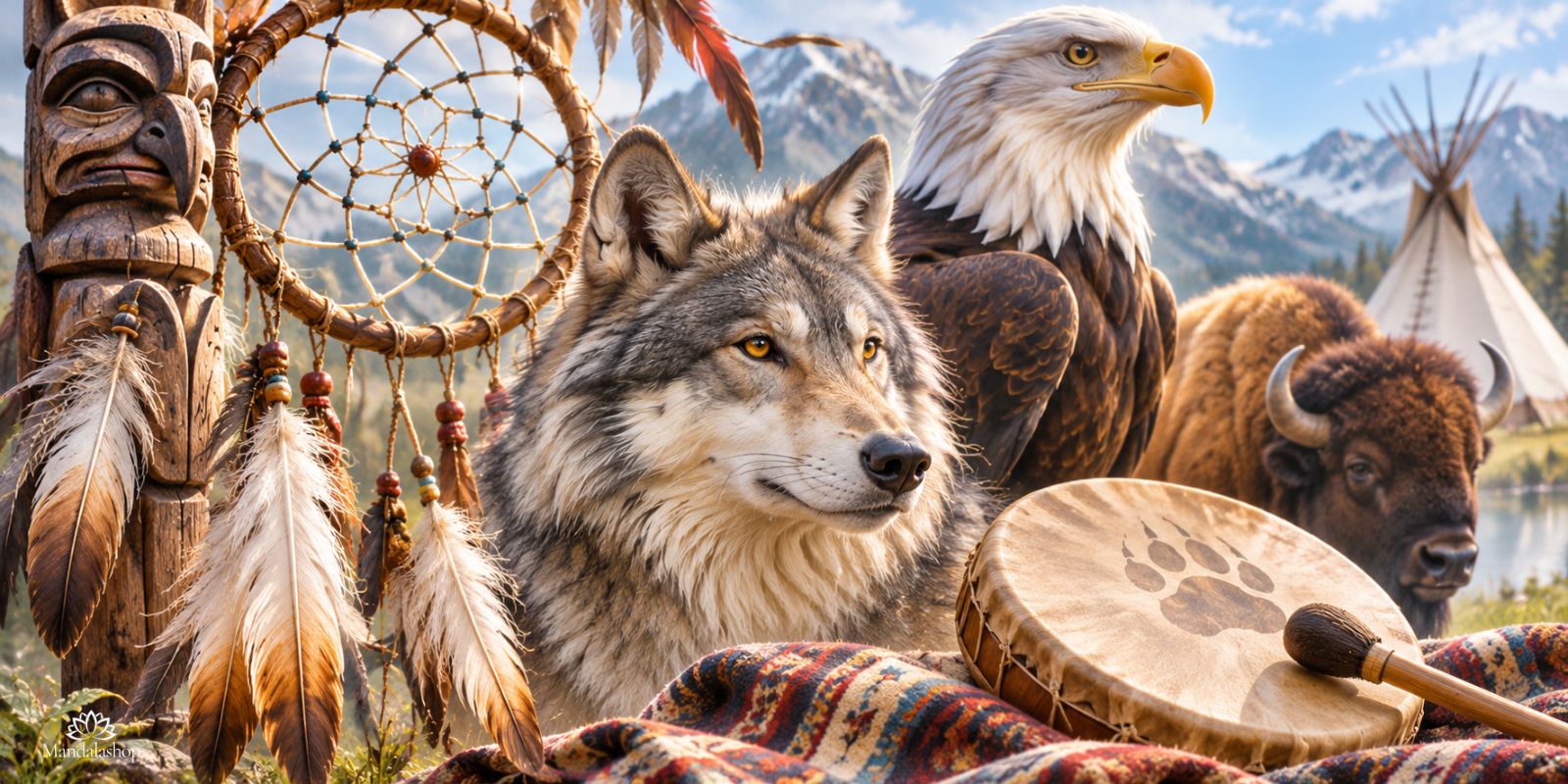
Among many peoples, particularly on the Pacific Northwest coast, certain animals are associated with clans or family lineages. The raven, eagle, bear, or wolf can thus represent ancestral ties, stories passed down from generation to generation, or a sense of collective belonging.
The famous totem poles illustrate this aspect. Contrary to popular belief, they are not simply objects intended to invoke protective spirits. They can tell a family’s story, honor its ancestors, represent its emblems, or commemorate important events.
In other Indigenous traditions, animals feature in stories, visions, or spiritual teachings. They can be viewed as beings with whom humans maintain special relationships, based on respect and reciprocity.
A spirit animal, therefore, is not simply an animal that corresponds to our personality. Depending on the tradition, it may be linked to a family history, a community, or a specific spiritual relationship.
How can you find out what your spirit animal is without taking a quiz?
If quizzes and birth calendars can’t provide a definitive answer, how can you discover your totem animal?
There are different ways to explore this connection. Some people have always felt a special connection to an animal, while others discover it through their dreams, meditation, or shamanic practices.
These approaches are not all based on the same traditions or the same conception of the totem animal. Nevertheless, they offer different avenues for exploring our connection with the animal world.
Listen to Your Intuition and Your Connection with Animals
Have you always been fascinated by a particular animal, without really knowing why? Perhaps since childhood, or following an encounter that left a deep impression on you.
It might be an animal you admire, whose behavior intrigues you, or with which you feel a strange sense of familiarity.
Sometimes this attraction is worth exploring. What is it about this animal that moves you? Its freedom, its power, its discretion, its ability to live in a group, or, on the contrary, its independence?
However, it’s important to distinguish between the animal you prefer and the one with which you feel a deeper connection. You may find an animal magnificent without feeling a particular connection to its symbolism. Conversely, an animal that didn’t particularly appeal to you may take on unexpected meaning during a personal experience.
Intuition can thus serve as an initial lead to follow, without trying to force an answer upon it.

Paying Attention to Your Dreams and Memorable Encounters
Sometimes the same animal appears regularly in our dreams, or an unusual encounter leaves a lasting impression on us.
In certain spiritual traditions, these experiences are interpreted as possible manifestations of a spirit animal. But before looking up their meaning in a dictionary of symbols, why not consider what they mean to you personally?
What emotions did you feel? In what context did this animal appear? Did its behavior make a particular impression on you?
A wolf that appears in a dream will not necessarily have the same meaning for someone who associates it with freedom as it does for someone who is afraid of it.
The context and your feelings give these experiences a personal dimension. And don’t forget that an encounter with an animal—even a repeated one—isn’t necessarily a sign that needs to be interpreted. Sometimes, an animal simply crosses our path!
Exploring Meditation and Visualization
Meditation offers another way to explore our symbolic relationship with animals.
By taking the time to quiet the mind and let images emerge, some people discover animal representations they would not have thought of spontaneously.
A visualization exercise might, for example, involve imagining a natural landscape and freely observing what appears: a forest, a clearing, a river… and then, perhaps, an animal.
The idea is not to decide in advance which animal you want to encounter, but to let the experience unfold without any particular expectations.
What if no animal appears? That doesn’t mean you’ve failed. This moment can simply be an opportunity to refocus and pay closer attention to your inner world.
The Shamanic Drum Journey and the Encounter with One’s Power Animal
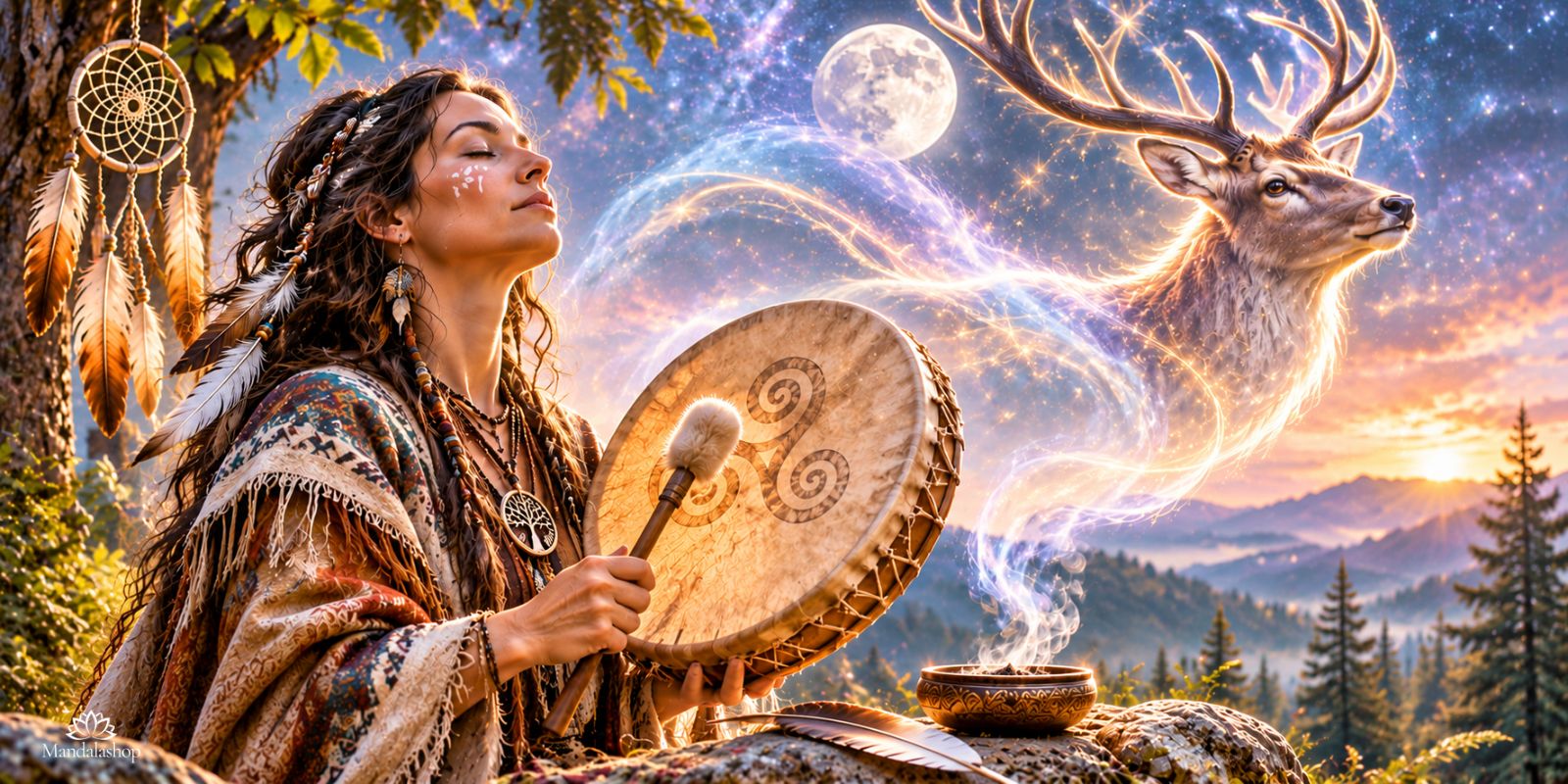
In certain shamanic practices, the encounter with a power animal takes place during an inner journey accompanied by the repetitive rhythm of the drum. This approach was notably developed and taught by anthropologist Michael Harner, founder of the Foundation for Shamanic Studies, as part of what he called “Core Shamanism,” or fundamental shamanism.
The rhythm of the drum facilitates entry into an altered state of consciousness, during which the practitioner may seek to encounter a power animal.
In this approach, the animal is not simply viewed as a reflection of a personality trait. It is viewed as a spiritual ally, with whom a relationship can develop over the course of various experiences.
An important clarification: the terms “spirit animal” and “power animal ” are often used interchangeably, though they do not necessarily refer to the same concept depending on traditions and practices.
To explore the shamanic journey, you can participate in a workshop led by an experienced guide. The experience remains a personal one, both in how it unfolds and in how each person interprets it.
Exploring Animal Symbolism to Gain a Better Understanding of Ourselves
You don’t have to attend a workshop or have a specific spiritual experience to develop an interest in animal symbolism. Simply observing animal behavior, discovering their role in different cultures, or reflecting on the qualities they represent can already open up interesting avenues of exploration.
Does the fox invite us to reflect on our ability to adapt? Does the bear remind us of the importance of preserving our personal space? Does the butterfly symbolize a transformation we are currently undergoing?
These associations are not universal meanings. They take on meaning through our history, our sensibilities, and the experiences we go through.
And sometimes, discovery doesn’t come from a long search. It emerges when we least expect it, with that strange feeling of recognizing something we already knew, without ever having truly put it into words.
My Personal Experience: An Unexpected Discovery
Many years ago, I took part in an animal communication workshop where the second day was devoted to discovering our spirit animal through a shamanic practice accompanied by drumming.
We worked in pairs, and what made this experience unique was that it wasn’t up to us to discover our own animal—it was up to the other person to do so for us.
I still remember the moment my partner told me which animal she had discovered for me. I literally burst out laughing! Not because the result was ridiculous or surprising—quite the opposite. It was so obvious that I wondered how it could have been any other way.
This animal had already been part of my world for a long time. I had often recognized myself in its temperament, its way of being, and the qualities it symbolizes. Yet I had never really made the connection with the concept of a spirit animal.
I’d rather keep its identity to myself, since this discovery is part of my personal story. But what I can share is that feeling of immediate recognition—almost as if someone had just put into words something I already knew intimately.
Would I have gotten the same result with an online test? Maybe. Or maybe not.
What made this experience so special to me wasn’t just the animal that was revealed to me, but the way this discovery resonated within me. And perhaps that’s where the real difference lies: beyond the name of an animal, what matters is the meaning this encounter holds in our lives.
What Can Our Spirit Animal Teach Us?
Discovering your spirit animal can be a life-changing experience. But once the initial surprise of this encounter has passed, another question arises: what are we going to do with this discovery?
Because, ultimately, the point isn’t just to know which animal accompanies us, but to understand what it can teach us.
In certain spiritual traditions, the spirit animal is viewed as a guide or ally, whose teachings are revealed gradually. From a more symbolic perspective, it can become a powerful tool for self-discovery.
And sometimes, these two approaches converge.
A reflection of our personality, our strengths, and our vulnerabilities
Every animal possesses characteristics that fuel our imagination and with which we associate certain qualities. The wolf readily evokes loyalty and instinct, the eagle freedom and vision, while the owl often symbolizes wisdom and intuition.
But reducing an animal to just a few qualities would mean missing out on much of its symbolic richness.
Take the bear, for example. Its power can evoke strength and protection, but also the need to set boundaries and preserve one’s space. The fox, often associated with intelligence and adaptability, can also make us question our tendency to sidestep difficulties rather than face them head-on.
Our spirit animal, therefore, does not necessarily reflect an idealized image of ourselves. It can also shed light on aspects of our personality that we know less well—or that we sometimes prefer to ignore.
And this is perhaps where its lesson becomes most interesting: not by telling us who we are, but by inviting us to look at certain facets of ourselves with greater clarity.
How does our spirit animal communicate with us?
Do we have to wait for a sign, a dream, or an unusual encounter to receive a message from our spirit animal?
In certain spiritual traditions, spirit animals can manifest through dreams, visions, or experiences perceived as synchronicities. These manifestations are then interpreted in light of each person’s beliefs and spiritual journey.
But there is also a simpler way to view this relationship. Our spirit animal can speak to us through what it stirs within us—a particular emotion, a sense of familiarity, a quality we admire, or a behavior in which we deeply recognize ourselves.
It can also speak to us when we observe its way of life. Does a solitary animal invite us to reflect on our need for independence? Does an animal that lives in a group remind us of the importance of mutual support and the bonds we share with others?
These reflections don’t have to be extraordinary to be valuable.
Moreover, there is no universal dictionary for interpreting the messages of a spirit animal. The same animal can evoke very different things depending on the person, their history, and the traditions they draw upon.
Rather than systematically seeking an external interpretation, it may be worthwhile to ask yourself: “What is this animal awakening or prompting me to question within myself today? ”
How can your spirit animal inspire you daily?
Your relationship with your spirit animal doesn’t necessarily end once you’ve discovered it. It can evolve, deepen, and take on different meanings depending on the stages of your life.
It’s not about trying to imitate an animal, but about drawing inspiration from what it represents to you.
If your animal symbolizes courage, its symbolism can guide you when you have to make a difficult decision. If it represents patience, it can remind you that not everything needs to be done in a hurry. And if it embodies freedom, perhaps it will invite you to reflect on the importance you place on your own aspirations.
Some people like to meditate on the symbolism of their animal; others prefer to keep a journal to record their dreams, feelings, or the reflections that this relationship inspires in them.
You can also choose to keep a representation of this animal close by: an illustration, a decorative object, or a piece of jewelry that serves as a personal reminder of its qualities and lessons.
What matters most is not the object itself, but the meaning we give it.
And above all, there’s no need to freeze this relationship in time. What moves us about an animal today may take on an entirely different dimension a few years later.
Perhaps the most beautiful lesson our spirit animal teaches us is precisely this: to get to know ourselves better, while accepting that we, too, are beings in constant evolution.
What is my spirit animal quiz. Is it absolutely necessary to know it?
If we spend too much time searching for our spirit animal, we might almost end up believing that we’re missing a crucial piece of the puzzle until we find the answer!
Yet discovering a spirit animal is neither an obligation nor a race for results. Some people have a profound experience, others feel a deep connection to an animal from childhood, while still others feel no particular connection at all.
And it isn’t necessarily necessary to search for a single animal that will accompany us throughout our entire lives. According to spiritual traditions, several animals can play a role in our journey, each with its own symbolism and lessons.
So, rather than taking countless tests in the hope of finally finding “the right” animal, why not take the time to discover what animals represent and observe the ones that particularly resonate with you?
After all, perhaps the most important thing isn’t to find your spirit animal at all costs, but to understand why certain animals resonate so deeply within us.
To continue this exploration, I invite you to check out our guide “Spirit Animals: List and Meanings.” From wolves to butterflies, owls, deer, and ravens, each animal possesses a fascinating symbolic world.
Perhaps you’ll find the one that speaks to you… or simply a new way of looking at the animal kingdom.
What about you—what do you think of spirit animal quizzes?
Have you ever taken a quiz to discover your spirit animal? Did the result seem accurate, surprising… or completely off the mark?
And beyond the quizzes, is there an animal you feel a special affection or attraction toward? An animal that has fascinated you since childhood, whose qualities you admire, or with which you spontaneously identify?
Tell us about it in the comments! Do you think these affinities have a special meaning, or do they simply reflect our personality and sensibilities?
I’d love to hear about your experiences and thoughts!
We've reached the end of this article. I hope you enjoyed it.
Feel free to comment, share, and subscribe to our newsletter to stay informed about upcoming posts.
Sources and References
• Smithsonian – National Museum of the American Indian: Honoring Animal Relatives
• Smithsonian Folklife: Land and Native American Cultures
• Michael Harner – Foundation for Shamanic Studies: Core Shamanism
• Bertram R. Forer (1949): The Fallacy of Personal Validation

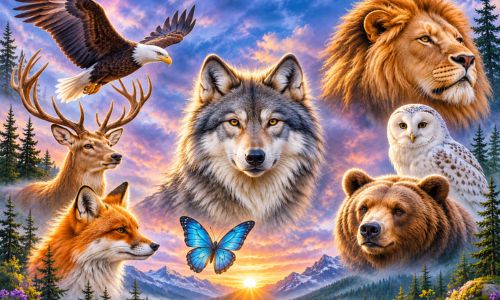


 Spirit Animal Quiz: Can You Really Trust the Results?
 List of Spirit Animals and Their Meanings
 End of an Era: Are We on the Threshold of a New World?

