
Samhain: What Does the Dark Season Really Reveal?

As fall progresses, nature sheds its leaves. The trees lose their leaves, the days grow shorter, and the light becomes more subdued. What was still vibrant just a few weeks ago seems to be gradually fading away.
It is at this particular time of year that Samhain takes place, an ancient celebration of Gaelic origin marking the transition into the dark season. Associated with the dead, ancestors, and the Otherworld in ancient traditions, it now holds an important place in Wicca and various contemporary spiritualities.
But reducing Samhain to a festival of the dead or the precursor to Halloween would miss what makes this time of year so fascinating.
For when the light outside fades, our perspective, too, can shift. Nature’s cycle then confronts us with questions we sometimes prefer to leave in the shadows: our relationship to death, the invisible, transformation, and what remains when appearances fade.
In this article, we’ll trace the origins of Samhain before exploring its spiritual significance. We’ll also see how its symbolism resonates with the reflections of other spiritual traditions on the dark season, inner light, and cycles of transformation.
What if Samhain’s true invitation were not to push back the darkness, but to learn to see differently what it can reveal to us?
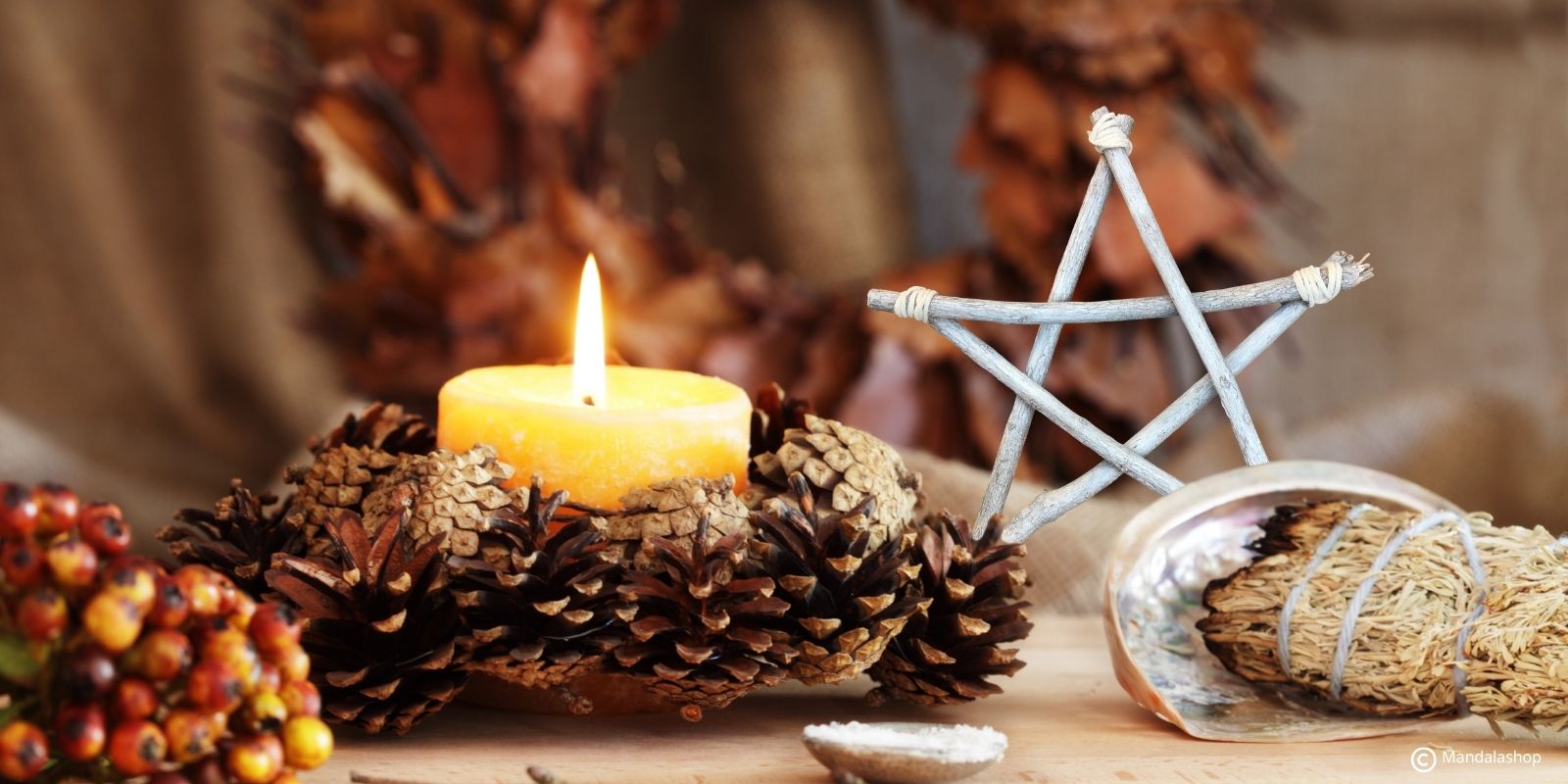
Samhain Festival: Origin, Meaning, and Date
Samhain is today surrounded by many beliefs: a festival of the dead, the witches’ New Year, the night when the world of the living is said to draw closer to that of the spirits… But behind these representations lies a more complex history, shaped by Gaelic traditions and then by centuries of change.
Before exploring the spiritual meaning of Samhain, let’s return to its origins, its special place in the calendar, and what this festival represents today. These points of reference are essential for distinguishing the ancient heritage from more recent interpretations.
What is the origin of Samhain?
Samhain is an ancient Gaelic festival marking the beginning of winter. Its name, derived from Old Irish, is generally interpreted to mean “end of summer.”
In Ireland’s pastoral societies, this period marked a tangible change in the rhythm of life: the harvests were coming to an end, the herds were returning from pasture, and the community was preparing for the darkest months of the year.
Samhain also had a supernatural dimension. Several medieval Irish tales place encounters between humans and beings from the Otherworld during this period. However, we must avoid projecting our modern conceptions onto these ancient traditions: this Otherworld was not simply conceived as the realm of the dead, but as a supernatural reality distinct from the human world.
British historian Ronald Hutton rightly urges caution when studying ancient seasonal festivals: not all contemporary customs can be presented as intact survivals of Celtic practices. Samhain has ancient roots, but its meaning has also evolved over the centuries.
When is Samhain celebrated?
Samhain is now primarily celebrated on the night of October 31 through November 1. In the traditional Gaelic calendar, it marks the beginning of winter and falls approximately halfway between the fall equinox and the winter solstice.
This timing is important for understanding its symbolism. At the equinox, day and night are nearly equal in length. By Samhain, the nights have gained the upper hand. At the winter solstice, they will reach their maximum length before the days begin to grow longer again.
In Wicca and certain Neopagan traditions, Samhain is now one of the eight sabbats of the Wheel of the Year. Some traditions also consider it the beginning of a new spiritual year.
What is the spiritual meaning of Samhain?
The spiritual meaning of Samhain is that of a transition: a transition from the light season to the dark season, from one cycle coming to an end to another beginning, but also, symbolically, from the visible world to the invisible. In Wicca and certain neo-pagan traditions, this sabbat is associated with death, ancestors, transformation, and the idea that the boundary between the worlds becomes more tenuous.
Samhain, therefore, does not celebrate death as an isolated end. Its symbolism places it within a broader cycle where passing, rest, and renewal are interconnected. Just as nature enters its dark season, that which ceases to be visible is not necessarily devoid of life or potential.
This is what makes the threshold an essential concept for understanding Samhain. The festival falls between two seasons, but it also symbolically places us between presence and absence, the known and the unknown, the end and the beginning.
In a contemporary spiritual interpretation, this transition can then become an invitation to shift our perspective. As nature’s activity slows and the light outside dims, Samhain leads us to reflect on what remains when our usual points of reference fade away.
This interpretation should not be confused with a belief that can be attributed as such to the ancient Celtic peoples. It belongs to the meaning that contemporary spiritual traditions now ascribe to Samhain, drawing on its ancient association with the dark season and the Otherworld.
It is precisely this transition from external light to another form of light that we will now explore.

From the Samhain Sabbath to the Journey Toward Our Inner Light
In the wheel of the year, Samhain is not an isolated event. It is part of a process that began several weeks earlier, whenthe fall equinox marks the balance between day and night. As we then move toward winter, the external light diminishes and nature shifts its rhythm.
This progression can also be interpreted symbolically. Many spiritual traditions have viewed fall as a time when our attention—less distracted by the expansion of the external world—can gradually turn inward. Samhain thus becomes a special stage in this journey: the point at which the dark season is fully underway.
From the Equinox to Samhain: The Dark Season
The fall equinox, around September 22 or 23 in the Northern Hemisphere, marks the time when day and night are nearly equal in length. Samhain, celebrated a few weeks later, falls roughly halfway between this balance and the winter solstice. By then, the nights have become longer than the days.
In contemporary Druidism, the fall equinox is notably celebrated under the name Alban Elfed. It is associated with the harvest, gratitude, and balance before entering the dark half of the year.
Maria Ede-Weaving, author and member of the Order of Bards, Ovates, and Druids, uses a particularly evocative image to describe this: that of a journey toward the center of a spiral. As the year moves toward winter, this symbolic movement is said to gradually lead us back to an inner space of rest and renewal.
This spiral offers a different perspective on the path leading to Samhain. The equinox still represents a point of balance between light and darkness; by Samhain, we have crossed the threshold. The dark season has begun.
Why turn inward?
Turning inward does not mean cutting oneself off from the world. In a spiritual interpretation of the cycle of the seasons, it is rather a matter of symbolically accompanying nature’s movement: after expansion comes withdrawal, after activity comes rest, and after what manifests comes what is preparing itself out of our sight.
Autumn thus confronts us with an unusual experience in societies where we are constantly encouraged to produce, move forward, and project ourselves toward the next stage: not all fruitful movement is necessarily visible.
This idea, moreover, extends beyond traditions directly linked to Samhain.
In his lectures on the period of St. Michael’s Day, Rudolf Steiner describes autumn as a time when the movement of consciousness shifts. While in spring and summer human beings are more drawn to the external natural world, the autumnal decline, according to him, calls upon them to develop within themselves the forces they can no longer receive in the same way from the external world.
Steiner is not writing here about Samhain, and his approach belongs to anthroposophy, not Wicca. But the parallel is interesting: in two very different traditions, the diminishing of external light can serve as a catalyst for a movement toward inner life.

Rediscovering Our Inner Light
Inner light does not refer to light in the physical sense. In a spiritual context, it can symbolize what allows us to find our way when our external points of reference become less obvious: consciousness, intuition, discernment, or the perception of what gives meaning to our existence.
This is where the dark season takes on a special meaning. It does not necessarily invite us to fight the darkness, but to discover whether we are capable of finding our way in a different way when it becomes impossible to see everything.
Light and darkness then cease to be mere opposites. One reveals the world around us; the other can create the conditions for a different kind of attention.
From this perspective, Samhain marks a particularly powerful threshold: when the outer light dims, what can still illuminate us from within?
This question leads us to the heart of one of Samhain’s most mysterious symbols: the idea that at this time of year, the veil between the visible and invisible worlds becomes thinner.
Samhain: The Veil Between Worlds
Samhain has long been associated with a special time of year, when the usual boundaries seem to become less distinct. Between the living and the dead, the visible and the invisible, the known and the unknown, this night symbolically occupies a space of its own.
It is from this idea that one of Samhain’s most powerful images was born: that of a “veil between the worlds ” that grows thinner. But what does this expression really mean, and what can it teach us about our own relationship with the invisible?
Why do we talk about a veil between the worlds?
At Samhain, the “veil between the worlds” refers to the belief that the boundary between our world and the unseen becomes more permeable. This phrase is most commonly used in contemporary spiritual traditions, but it finds an echo in medieval Irish tales, where Samhain appears as a special time for encounters with the Otherworld.
This Otherworld was not simply the realm of the dead. In Irish tradition, it refers to a supernatural realm populated by beings who obey laws different from those of the human world. To describe Samhain as a night during which “the dead return among the living” would therefore be an oversimplification.
In Wicca and certain contemporary neo-pagan traditions, this ancient connection to the Otherworld has taken on a new dimension. Samhain has become a special time to honor the deceased and ancestors, to remember those who have gone before us, and—for those who share this belief—to become more attuned to the spiritual world.
Honoring ancestors does not necessarily mean seeking to communicate with them. It can simply involve acknowledging what they have passed down: a history, traditions, values, sometimes a few memories, but also everything that continues to influence us, even if we are not always aware of it.
What does the veil represent on a spiritual level?
The veil of Samhain can also be understood as a symbol of the boundary between what we perceive and what eludes us.
We instinctively trust what we can see, measure, or explain. Yet a significant part of our existence is invisible: our memories, our intuitions, the bonds that unite us with others, or even the imprint left within us by those who are no longer here.
In an inner interpretation of Samhain, the thinning of the veil does not necessarily mean that another world suddenly becomes accessible. It may also invite us to become more attentive to what exists beyond our immediate perception.
Perhaps this is one of Samhain’s most fruitful mysteries: reminding us that the invisible is not necessarily synonymous with absence.
This question takes on an even deeper dimension when it intersects with that of death. For if something can remain even as a form disappears, what does the end of a cycle truly mean?

Samhain and Symbolic Death: The Mystery of Transformation
Death lies at the heart of the Samhain tradition. But it does not refer solely to the deceased or the afterlife. Through the cycle of nature, it can also be understood as a symbol of transformation: one form disappears while another possibility takes shape.
This interpretation extends beyond Samhain itself. Many spiritual traditions have seen in the transformations of autumn a reflection of the transitions that human beings go through.
Death and Rebirth in the Cycle of Nature
At Samhain, nature shows fewer visible signs of growth. Leaves fall, vegetation slows down, and the earth gradually enters its winter rest. Yet this barrenness is part of the cycle of life: what disappears in one form is transformed and sets the stage for new life.
Death and life thus appear less as two opposing realities than as two moments within the same process.
This idea finds a particularly interesting echo in the teachings of Omraam Mikhaël Aïvanhov. In his teachings on autumn, he describes this season as a time of separation and “sorting.” In this regard, he quotes a phrase attributed to Hermes Trismegistus in the Emerald Tablet: “You shall separate the subtle from the dense,” which he interprets as the separation of the spiritual from the material.
Aïvanhov observes this same process in nature: the fruit separates from the tree, then the seed from the fruit. Autumn thus becomes the time when something detaches itself to allow the cycle to continue and “prepare for new life.”
Aïvanhov is not referring to Samhain here. But the comparison opens up an interesting interpretation: behind what falls, disappears, or falls apart, what remains that is essential?
What does “symbolic death” mean?
Symbolic death refers to the transition from one state to another: something about our former way of being, thinking, or perceiving the world comes to an end, without us always knowing immediately what will follow.
This is a deeper interpretation than the common advice to “let go of what no longer serves us,” which is often associated with Samhain today. Some transformations are not a matter of choice. An experience, a separation, an encounter, or simply the passage of time can alter our perspective to the point where returning to who we were before becomes impossible.
The phrase “separating the subtle from the dense” can then take on a deeper, inner resonance. Without necessarily interpreting it literally, it invites us to ask ourselves what, during a period of transformation, belongs to a form that has become obsolete and what, on the contrary, deserves to be preserved, passed on, or explored more deeply.
There are thus moments when the old is no more, but the new has not yet taken shape. Samhain symbolically places us in this in-between space.
Why can the dark season be difficult?
In some spiritual traditions, the Samhain period is considered particularly intense because the boundary between the visible and invisible worlds is more permeable. If the “veil” grows thinner, it would not only allow us to perceive more—it would also make us more sensitive to influences or energies that are usually less perceptible.
This idea adds another dimension to the dark season. This inward turn is not merely caused by the diminishing light or nature’s slowing pace. It may also correspond to a period of greater receptivity, during which some people feel more sensitive, experience unusual emotions, or feel a stronger need to refocus.
This does not mean that every feeling of fatigue, sadness, or emotion experienced in the fall has a spiritual origin. The decrease in natural light and the seasonal shift in rhythm also have very real effects on our bodies. Both interpretations can coexist without being confused.
On a symbolic level, this greater permeability also explains why practices associated with Samhain place such importance on protection, grounding, and discernment. Opening oneself to the invisible does not mean opening oneself indiscriminately to everything that comes along.
The phrase attributed to Hermes Trismegistus, “separate the subtle from the gross,” thus takes on added significance. The Samhain season invites us not only to perceive more, but also to discern: What belongs to us? What influences us? And, amid all that passes through us, what truly deserves our attention?
Samhain Ritual: How Can We Experience This Transition Internally?
Understanding the symbolism of Samhain is one thing; making it a personal experience is another. You don’t need a complex ritual to do this. A few minutes of silence can be enough to give this transition a sense of inner reality.
The idea isn’t to reenact an ancient rite, but to create a moment inspired by the themes we’ve explored: transformation, memory, the invisible, and this special time when one cycle ends before the next takes shape.
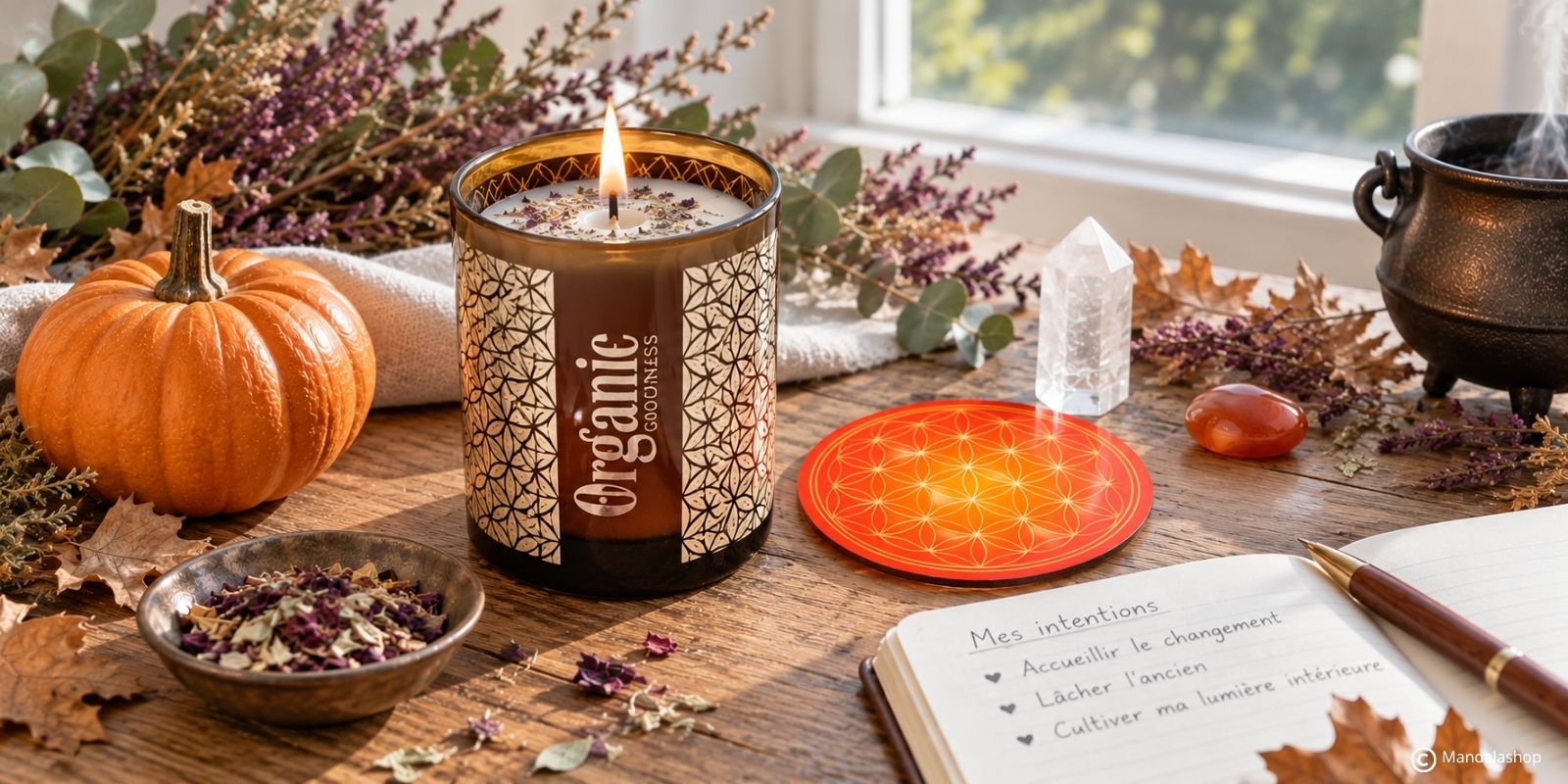
A Simple and Introspective Samhain Ritual
To perform a Samhain ritual, choose a quiet moment, ideally at dusk. Turn off the artificial lights and light a candle. Its flame can symbolize the inner light that remains present at the heart of the dark season.
Take a few moments to observe the flame and let silence settle in. Then simply ask yourself these three questions:
• What has undergone a profound transformation within me this year?
• What lives on within me from those who have gone before me?
• Can I accept that I don’t yet know what is seeking to emerge?
Don’t feel you have to answer immediately. The value of this moment also lies in the space you allow these questions to occupy.
If you wish to honor a departed loved one or your ancestors, you can recall a memory, say a name, or simply dedicate a few moments of silence to them. The candle then becomes a symbol of presence, memory, and light.
What symbols should you choose for Samhain?
Samhain symbols aren’t limited to representations of death or fall. In your personal practice, you can choose a symbol based on the intention you wish to set for this occasion.
A candle’s flame naturally evokes light in the darkness. The Triple Moon symbolizes cycles and transitions. The pentagram, which is very common in contemporary Wicca, can symbolize the union of the elements and the spirit. The witch’s knot, meanwhile, is traditionally associated with protection in modern esoteric practices.
A candle holder, a pendant, or a symbol placed near you can thus serve as a focus for your attention. The object does not walk the path for you; it gives visible form to the intention you have chosen.
When you feel that this moment is over, blow out the candle.
Darkness returns. But perhaps you no longer view it quite in the same way.

Samhain and Halloween: Two Celebrations, One Mystery?
Samhain and Halloween are celebrated around the same time and today share a common imagery associated with death, spirits, and the uncanny. However, it would be too simplistic to present them as two versions of the same holiday.
Their history has been shaped by Gaelic traditions, Christian holidays, and folk customs that have evolved over the centuries.
What is the difference between Samhain and Halloween?
Samhain is an ancient Gaelic festival marking the beginning of winter, while Halloween is the result of a later history blending various influences. Halloween is therefore not simply the modern version of Samhain, even though certain traditions associated with both festivals have merged over time.
The word “Halloween” comes from “All Hallows’ Eve,” the eve of All Saints’ Day. Over the centuries, Christian observances of the dead became intertwined with various folk customs from the British Isles and Ireland. In the 19th century, Irish and Scottish immigration helped bring some of these traditions to North America, where Halloween gradually took on the form we know today.
Samhain and Halloween nevertheless share a particularly interesting commonality: both symbolically confront the living with death.
Today, Halloween readily does this through costumes, games, fear, or humor. Samhain, in the contemporary spiritual traditions that celebrate it, places greater emphasis on remembering the deceased, the cycles of nature, and introspection.
Ultimately, these are two very different ways of approaching the same reality—one that our societies often tend to keep at a distance.
And perhaps this is also why these celebrations continue to fascinate us: for a few hours, death steps out of the shadows and symbolically returns among the living.
What if the dark season taught us to see things differently?
Samhain confronts us with something our era often seeks to avoid: not everything can remain, last, or endure in the same form.
Nature reminds us of this every fall. But far from reducing this time to a mere celebration of death, Samhain invites us to look differently at the transitions of life—at what disappears and what continues to dwell within us.
Perhaps this is what entering the dark season is really about: accepting that we cannot illuminate everything immediately. Not to renounce the light, but to discover that there are other ways of seeing.
And you—what does Samhain mean to you? A time to honor those who have gone before you, a period of introspection, a transition into the dark season… or something entirely different?
Share your perspective in the comments: it might, in turn, shed light on another reader’s experience.
We’ve reached the end of this article. I hope you enjoyed it.
Feel free to comment, share, and subscribe to our newsletter to stay informed about upcoming posts.
Sources and References
For further reading on the history of Samhain, Irish traditions related to the Otherworld, and the various spiritual interpretations discussed in this article:
• Ronald Hutton, *The Stations of the Sun: A History of the Ritual Year in Britain*, Oxford University Press, 1996—particularly the chapters on Samhain, the festivals of the dead, and Halloween.
• John Carey, “Samhain,” The Oxford Companion to Irish History, Oxford University Press, 1998.
• John Carey, “The Location of the Otherworld in Irish Tradition,” *Journal of Irish Studies*, vol. 19, 1982.
• University College Cork, Department of Early and Medieval Irish, “Secrets at Samhain”—on Samhain in medieval Irish literature and encounters with the Otherworld.
• Maria Ede-Weaving, “Autumn Equinox / Alban Elfed Solo Ritual,” Order of Bards, Ovates & Druids – on the contemporary symbolism of the autumn equinox and the spiral path.
• Rudolf Steiner, “The Michael Inspiration,” lecture of October 15, 1923, and “The Michael Imagination,” lecture of October 5, 1923 – on the spiritual significance of fall, self-awareness, and the development of inner forces.
• Omraam Mikhaël Aïvanhov, The Fruits of the Tree of Life – The Kabbalistic Tradition, Complete Works, Volume 32, Chapter XVII, Prosveta Editions – on the symbolism of fall as a period of separation and transformation preparing for new life.


 Samhain: What Does the Dark Season Really Reveal?
 Viking Symbols: Myths, Mysteries, and Truths
 Spiritual tattoo: do tattoos really have an effect?
